AI referral program rules: credit, timing, and self-referrals
Create AI referral program rules that define credit, timing, payouts, and self-referral prevention so customers trust the program and disputes stay rare.
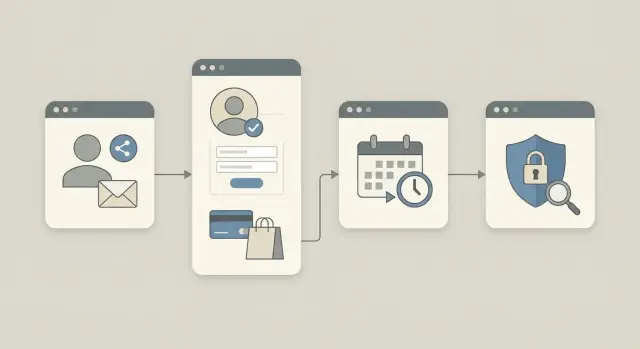
Why clear referral rules matter
Referral programs fail for one boring reason: nobody agrees on what counts. One person expects credit for a friend who clicked a link. Another expects credit only after money changes hands. Meanwhile your team is stuck replying to angry emails instead of building.
If you're a founder or a small team, you don't have time for case-by-case decisions. Clear referral rules reduce support load, protect your margins, and help good referrers feel comfortable promoting you.
Most disputes fall into three buckets:
- Credit: Who gets the reward when multiple people claim the same customer, or when the customer signs up with a different email later?
- Timing: When is a referral approved, and when does the payout happen (trial start, first payment, after refunds)?
- Edge cases: What about returns, chargebacks, cancelled subscriptions, or a customer who signs up on mobile after clicking on desktop?
Simple rules beat clever rules. The more loopholes you leave, the more creative people get. You don't need a 20-paragraph document that tries to predict every rare scenario. You need rules that make 95% of situations obvious and the other 5% easy to resolve without drama.
Here's a common scenario: a customer clicks Referrer A's link, then later gets a coupon from Referrer B and purchases. If your policy doesn't say whether first touch or last touch wins, you'll end up negotiating in DMs. That's where trust erodes.
If you're using AI tools to move fast (common with early prototypes), it's even more important to write rules that a non-lawyer can understand. Treat your referral rules like product UX: short, clear, and tested by someone who wasn't in the room when you wrote them.
Decide your goal and what counts as a referral
Before you write rules, pick one primary goal. If you try to optimize for signups, paid customers, and upgrades at the same time, you end up with confusing edge cases and unhappy referrers.
Choose a goal that matches what you can verify easily. For a service business, that might be "paid project started" rather than "site visit." For SaaS, it's often "first paid invoice" instead of "trial signup." The more measurable the goal, the fewer arguments you'll have.
Once the goal is clear, define the exact event that earns credit and what "valid" means. Aim for a definition a support person can apply in 30 seconds.
A solid definition usually answers a few concrete questions: what triggers credit (signup, first payment, upgrade), what confirms it (email verified, payment captured, invoice paid), whether there's a minimum threshold (plan level, order amount, retention period), who can refer, and which products or plans qualify.
Also state what does not count, even if it feels obvious. Refunds, cancellations, and chargebacks are where most disputes start. Keep exclusions plain and specific, for example: "If the purchase is refunded within 30 days, the referral reward is reversed." If you offer multiple plans, decide whether referrals apply to all of them or only to tiers where you have enough margin to pay rewards.
One quick reality check: if you can't verify the event using your billing system or CRM, it's a weak "counts as a referral" definition. Your rule should be measurable, not arguable.
Choose rewards people understand
The best reward is the one someone can explain in one sentence. If a person needs to read a page of fine print to know what they earn, they won't share it, and you'll spend your time answering questions instead of getting referrals.
Start by matching the reward to how people already pay you. Cash is simple but creates tax and payment overhead. Credits and discounts fit subscription products and services. Gift cards can be a universal option but add fees and delivery steps. Feature access can work when your premium tier is obvious and genuinely desirable.
To keep things clear, stick to a small number of reward shapes, like a fixed cash amount, a fixed account credit toward the next invoice, a simple one-time percentage discount, a gift card with a clear value, or time-limited premium access.
Add a cap so the program can't surprise you later. Keep it human: "up to 5 rewards per month" or "up to $500 lifetime per referrer" is easier to understand than multi-tier ladders.
Decide whether only the referrer gets the reward or whether both people do. Two-sided rewards often convert better because the new customer feels welcomed, not sold to.
If money is involved, say how you handle taxes, fees, and currency in plain language. For example: rewards are paid in USD, payment fees may be deducted, and participants are responsible for any taxes required in their country.
Set credit and attribution rules
Most referral fights start when two people think they earned the same reward. Your rules should answer one question: who gets credit, and why, even when tracking is messy.
Start by naming the moment that creates credit. For example: "Credit is created when the referred person becomes a paying customer." If you award credit at signup instead, say that. One clear sentence keeps your messaging consistent across email, social posts, and forwarded links.
Pick an attribution model
If multiple invites happen, choose one model and stick to it:
- First-touch: the first referrer who brought the person in gets credit.
- Last-touch: the most recent referrer before signup or purchase gets credit.
- Manual review: slower, but useful for high-value deals where edge cases are expected.
Make the choice real with an example in your terms. If someone sees how it works in a familiar scenario, they're less likely to argue later.
Set your tracking window and failure plan
Define a tracking window (for example, 30 days) and what resets it. Then explain what happens when tracking fails.
A simple fallback rule might be: "If cookies are blocked, we use the email entered at checkout to match the referral. If we still can't verify it, no credit is issued." People won't love every outcome, but they'll understand it.
Instead of a long list of tie-breakers, focus on the few conflicts that happen constantly:
- If the same email appears in multiple referral claims, the earliest valid referral wins.
- If a link is forwarded, credit stays with the original referrer unless a new referral link is clicked later.
- Only the first verified account for a new customer counts.
Also set a dispute window so issues don't drag on forever, for example: "Disputes must be reported within 14 days of signup or purchase."
If your business has a longer sales cycle (like a free consult that can convert weeks later), be explicit about whether credit is based on the initial request, the paid kickoff, or the invoice paid date.
Make timing and payout rules explicit
Confusion about timing creates most of the "Where's my reward?" tickets. Good rules separate three things: when a referral is recorded, when it becomes eligible, and when the reward is actually issued.
First, choose when credit is earned. Common choices are when the referred customer pays the first invoice, when they finish a free trial, or after they stay active for a set period. Pick the one that matches your risk. If churn is high, "after 30 days paid" is safer than "on signup."
Next, decide your payout schedule. You can approve credit immediately but pay weekly or monthly. If you use a minimum payout threshold (for example, pay only after $25 is earned), say it plainly so nobody expects a $5 payout the same day.
Refunds and cancellations need one clean clawback rule. State the window and what happens if the reward already went out (deduct from the next payout, or carry a negative balance until new rewards cover it).
Finally, define a small set of statuses so people always know where they stand:
- Pending: recorded but not yet eligible
- Approved: credit earned, waiting for payout
- Paid: reward sent
- Rejected: not eligible (duplicate, self-referral, refund, policy issue)
A concrete example: if you have a 7-day trial, you might set "Approved after first paid invoice" and "Paid on the first business day of each month," with a 30-day refund clawback. That's easy to understand and hard to argue with.
Prevent self-referrals and simple fraud
If your rewards have real value, some people will try to refer themselves or game the system. The goal isn't to police everyone. It's to set clear rules that keep the program fair and reduce arguments.
Start by defining self-referral in plain language. Include the common cases: the same person using a second email, someone in the same household, and coworkers using the same company card. If you sell to businesses, also define whether "same company" counts as self-referral.
Decide what you check (and say it upfront)
You don't need a huge list, but you should name the signals you may use to verify a referral, such as email patterns (aliases and plus addressing), billing name and payment method, device or browser signals where allowed, and basic timing patterns (for example, accounts created and purchased within minutes).
Avoid rules that punish normal behavior. A family member using the same home Wi-Fi can look suspicious even when it's legitimate.
What happens if abuse is detected
State the outcome calmly and clearly: you can reject the reward, reverse credits, and suspend accounts for repeated abuse.
Also include a simple review path for edge cases. For example: "If your referral was flagged, contact support within 14 days. We may ask for basic proof that the referral is legitimate and will manually review." This keeps honest referrers from feeling trapped by automation.
Step-by-step: use AI tools to draft and test your rules
AI can help you write referral rules quickly, but the real win is using it to surface gray areas before customers find them.
1) Draft rules from a simple prompt
Start with one template prompt and fill in your facts. Specific inputs produce clearer terms.
Write referral program rules.
Inputs:
- Goal: (ex: drive paid annual plans)
- Reward: (ex: $25 credit to referrer, 20% off to friend)
- Timing: (ex: credit after friend pays and stays 14 days)
- What counts: (ex: first-time customer, new email, new payment method)
- Exclusions: (ex: self-referrals, refunds, chargebacks, reseller deals)
- Tie-breakers: (ex: last-click, first-click, or coupon code wins)
Output:
1) One-page summary
2) Full terms
3) A table of “if this happens, then this is the outcome”
2) Make AI attack your rules (on purpose)
Ask it to list edge cases and propose clear answers. Use prompts like: "Friend clicks two links," "Friend uses a different email," or "Purchase is refunded on day 13." If you don't like the answer, change the rule, not the wording.
Then ask for a rewrite to a 6th to 8th grade reading level. If a sentence runs long, shorten it until it reads like something you'd say out loud.
Finally, run an internal test: invent 10 scenarios and have AI label each as credit or no credit, plus the payout date. Example: Sam refers Priya on May 1, Priya pays May 3, refunds May 10. Your terms should make the result obvious.
Tracking and reporting without complexity
You don't need a fancy analytics stack. You need consistent identifiers, a single source of truth, and reports that match how you actually pay rewards.
Start by choosing one identifier you'll track everywhere. A referral link works for web signups. A coupon code works at checkout. For small B2B programs, an inviter email may be enough. Mixing identifiers (link plus code plus manual notes) is where disputes start.
Next, decide where the source of truth lives. If rewards depend on payment, your billing system should be the authority for qualified purchases and refunds. If rewards depend on in-app actions (activation, usage), your app database may be the authority. Pick one, and only mirror what you need into other systems.
Reporting should answer support questions fast. A few views usually cover it: pending rewards (what's missing), approved rewards (ready to pay), paid rewards (when and how), and reversals (what rule triggered the reversal).
When someone asks, "Why didn't I get credit?" you should be able to pull one record that shows the referral identifier, signup date, qualifying event date, and the exact rule applied.
Example: a simple program that avoids arguments
Imagine a small SaaS with a 14-day free trial and two monthly plans ($29 and $99). You want a referral offer that feels fair, is easy to explain, and doesn't create support tickets.
These rule choices keep the peace:
- A referral counts when the invited person becomes a paying customer (trial signups don't count).
- Credit is based on the first paid invoice only.
- Rewards are issued 30 days after that first paid invoice (to cover refunds and failed payments).
- Only one referrer can get credit per new customer.
- Self-referrals aren't allowed.
Now the tricky parts, with real outcomes.
Self-referral example: Sam signs up for a new trial using a different email, clicks their own referral link, and pays with the same card used on their existing account. The system flags it because the payment method matches. Result: the referral is marked invalid, no reward is paid, and Sam keeps their original account.
Tracking failure example: Priya shares her link in a Slack group. A teammate clicks it on mobile, then later signs up on a work laptop and the tracking cookie is lost. The teammate emails support saying, "I used Priya's link." Your rules allow a manual review within 7 days of signup. Support checks basic signals (signup timing, any matching invite details, and whether Priya has a suspicious history). If it looks legitimate, you apply credit once as a courtesy.
Customer-facing wording to display in-app:
Referral rules (simple version)
You earn a reward when your friend becomes a paying customer. Trial signups do not count.
We credit rewards on the first paid invoice only, and we issue rewards 30 days after payment.
Self-referrals are not allowed (for example, using your own link with a different email). If we detect this, the referral is void.
Missing tracking? Ask us within 7 days of signup and we may apply credit after review.
Common mistakes that cause disputes
Referral fights usually come from mismatched expectations. If a referrer reads your rules one way and your support team reads them another way, you'll either pay twice or argue publicly.
These are the patterns that create the most support tickets:
- Using fuzzy words like "qualified" or "valid" without defining what qualifies (paid plan, minimum spend, whether a trial counts).
- Ignoring refunds and cancellations. If the customer refunds within 14 days, do you reverse the reward, delay it, or keep it?
- Adding too many tiers, exceptions, and bonus windows. If people need a chart to understand the reward, they'll assume the best case.
- Changing attribution rules midstream. Switching first-touch to last-touch (or changing the cookie window) without clear notice makes earlier referrers feel cheated.
- Treating tracking as the truth with no fallback. Ad blockers, mobile, and forwarded links fail. You need a simple manual review path.
If you use AI tools to draft rules, watch for placeholders and vague legal wording. AI can sound confident while hiding missing definitions. One practical habit is to keep a small "Definitions" block (Qualified Referral, Reward, Refund Period, Self-Referral) and only update it with dated change notes.
Quick checklist and next steps
Before you hit publish, make sure your rules answer the questions a tired support agent will get at 9pm.
Your minimum bar:
- Eligibility: who can refer, who can be referred, and any excluded countries, plans, or employees
- Credit: what event earns credit and what happens when multiple people claim the same customer
- Timing: when credit is locked (cooling-off period) and when rewards are delivered
- Anti-abuse: what counts as self-referral, how you handle duplicates, and whether coupon stacking is allowed
- Support: where disputes go, what proof you accept, and the deadline to request review
Pressure-test the rules with a few edge cases. If you can't answer these in one sentence each, you're not ready to launch:
- A customer clicks two referral links in one day - who gets credit?
- The referred person cancels, then re-subscribes next month - does credit come back?
- The referrer and referee share a payment method, device, or IP - is that blocked or reviewed?
- The referee uses a different email but the same name and billing address - does it count?
- A referral happens during a promo discount - can they stack rewards?
For launch, make sure the words and the system match. Update your landing copy and in-app messages, confirm tracking events fire, and set up a simple weekly report (new referrals, qualified referrals, rewards owed, disputes). Keep a couple of short support macros so replies stay consistent, and version your terms so you can point to what was active at the time.
If your referral flow lives inside an AI-built app and the tracking, auth, or payout logic is breaking in production, FixMyMess (fixmymess.ai) can diagnose the codebase and help turn a brittle prototype into something reliable before you scale the program.
FAQ
What’s the simplest way to define “a valid referral”?
Define it as one measurable event you can verify quickly, usually the first paid invoice or a paid project kickoff. Put the exact trigger in one sentence so support and referrers apply it the same way.
First-touch or last-touch—what should I choose for credit?
Pick one model and state it clearly: first-touch, last-touch, or manual review for high-value deals. If you don’t choose, you’ll end up negotiating every conflict, which is slower and feels unfair to everyone.
What do I do when tracking fails because of ad blockers or cross-device signups?
Use a short, clear fallback rule such as matching by the email entered at checkout, then allow a limited manual review window. If you can’t verify it after that, don’t issue credit, but explain the reason plainly to avoid back-and-forth.
When should a referral reward be paid out?
Separate three moments: when it’s recorded, when it becomes eligible, and when it’s paid. A common default is “approved after the first paid invoice” and “paid on a weekly or monthly schedule,” which reduces “Where’s my reward?” support tickets.
How should refunds, cancellations, and chargebacks affect rewards?
Use one clawback rule with a specific window, like reversing rewards for refunds or chargebacks within 30 days. If you already paid the reward, apply the reversal to the next payout or hold a negative balance until future rewards cover it.
How do I prevent self-referrals without annoying honest users?
Define self-referral broadly and in plain language, including using a second email, a shared household payment method, or the same company card if you sell B2B. Tell people upfront that suspected self-referrals are void and may be reviewed if they think it was a mistake.
What kind of reward structure creates the fewest disputes?
Stick to rewards people can explain in one sentence, like a fixed cash amount, a fixed account credit, or a simple discount. Add a cap that protects your margins, and avoid complicated tiers that require extra interpretation.
How long should I allow people to dispute missing credit?
Set a deadline, such as requiring disputes to be submitted within 7–14 days of signup or purchase. After that, treat the decision as final so old claims don’t keep resurfacing months later.
How can AI help me pressure-test referral rules before launch?
Have AI generate edge cases and then force it to decide “credit or no credit” based on your draft rules, using specific timelines and refund scenarios. If the answers feel inconsistent, change the rule itself until the outcome is obvious in one sentence.
My AI-built app keeps breaking—should I launch referrals anyway?
Don’t launch a referral program on top of unstable auth, billing, or attribution logic, because you’ll create support debt fast. If an AI-built prototype is breaking in production, FixMyMess can audit the codebase, repair the logic, and harden security so tracking and payouts work reliably before you scale.