Fixed-price vs hourly remediation: choosing a safer model
Fixed-price vs hourly remediation: learn how each model handles unknowns in messy code, what to ask up front, and how to reduce risk before work starts.
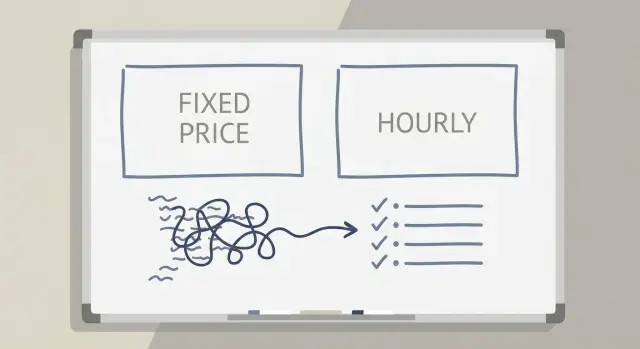
Why pricing gets tricky when the code is messy
Remediation is a simple idea: take software that kind of works and make it reliable. That means fixing the bugs you can see, plus the issues that only show up with real users, real data, and real security needs.
Pricing gets tricky because messy code hides work. You might open the app and see one obvious problem, like login failing. But the time sink is often the chain reaction behind it: broken session handling, missing database constraints, insecure shortcuts, or a deployment setup that was never finished.
AI-generated prototypes are especially good at looking complete while staying fragile. They often stitch libraries together fast, repeat patterns across files, and leave placeholders that look harmless until you go live. A prototype can pass a demo and still ship with exposed secrets, inconsistent validation, or logic that fails when two people use the app at the same time.
To a non-technical owner, “messy” usually feels like this: fixing one bug creates two more, features behave differently depending on page or device, and small changes take forever because nobody’s sure what will break. The app might work locally but fail in production, and you keep hearing terms like “spaghetti,” “hard-coded,” or “no tests.”
That’s why choosing between fixed-price and hourly remediation can be hard at the start. Both models are trying to answer the same question: how do you pay fairly when the full list of issues isn’t visible yet?
Unknowns are normal. They don’t mean your project is doomed. You can manage them if you treat discovery as part of the work. A “simple” checkout bug might actually be a database schema problem plus missing server-side validation. Until someone reads the code and traces real user flows, nobody can responsibly promise the exact effort.
A practical way to reduce uncertainty is to start with a short codebase diagnosis, then decide how to price the repair work based on what’s found.
Fixed price vs hourly: the simple definition
When people say “fixed price” (or fixed bid software repair), they mean you agree on three things up front: what will be fixed, what “done” looks like, and what it will cost. The work is treated like a package with clear deliverables.
Hourly bug fixing is simpler in a different way: you pay for time spent. The scope can change as the team learns more about the code. If a new issue appears, you don’t renegotiate the whole project every time. You decide whether to keep going based on progress and budget.
The real tradeoff is predictable cost vs flexibility.
Fixed price tends to work best when you want cost certainty and a clear finish line. Hourly tends to work best when you expect surprises and want room to pivot.
A quick example: imagine an AI-built prototype where login works on a demo link, but fails in production because secrets are exposed and the auth flow is inconsistent. If you already know the exact fixes needed, fixed price can work well. If you suspect there are more problems hiding behind the first error, hourly often reduces conflict because discovery is part of the plan.
What the unknowns usually are (and why they show up late)
Messy code hides problems the way a house hides water damage. Everything looks fine until you open a wall, run the shower, and realize the leak is behind the tiles. Software remediation is similar: the biggest risks often sit behind the first feature that fails in a real environment.
The unknowns that show up most often are predictable, even if the exact details aren’t:
- Authentication that works locally but fails with real sessions, cookies, or redirects
- Exposed secrets (API keys, database passwords) baked into code or logs
- Unclear data flow (no one knows where a value is coming from, or why it changes)
- Hidden dependencies, like a third-party service, a missing migration, or an assumed environment variable
- Security gaps that don’t show up in happy-path testing (unsafe queries, weak access checks)
These issues show up late because early testing is usually shallow. A quick click-through misses the parts that only appear under load, with real users, or with real data. If the app was generated quickly by an AI tool or patched by multiple people, the code may look readable while still being logically wrong.
Discovery work changes estimates because it turns guesses into facts. Until someone traces key flows end-to-end (login, payments, admin actions, data writes), you don’t know whether you’re fixing a small bug or pulling on a thread that unravels the whole sweater.
Unclear requirements make this worse. If nobody can say what “correct” behavior is, engineers end up chasing symptoms. In practice, the biggest unknown is often not the code - it’s the definition of “done,” especially around edge cases.
How fixed price handles unknowns
A fixed price can feel safer because you know the number up front. But it only works when “done” is clear. The real question isn’t the rate - it’s how the plan deals with surprises hiding in messy code.
With fixed price, uncertainty is handled by tightening scope. That usually means spelling out exactly what will be repaired, which environments are included, and what counts as success. If the app is “kind of working,” vague goals like “make it stable” are where fixed bids go wrong.
A healthy fixed-price agreement protects both sides with a few safeguards:
- Written acceptance criteria (what you’ll test and what must pass)
- Assumptions (for example: you can access hosting, key APIs still exist)
- Clear exclusions (what’s not included, like redesigning the UI or adding new features)
- A change request path (how surprises turn into new work, with a price and timeline)
- A phased option (diagnose first, then fix)
When surprises appear, a good fixed-price team doesn’t “eat” unlimited work or quietly cut corners. They pause and make the surprise visible. Then you choose: renegotiate the scope and price, or add a separate phase.
To avoid a bad fixed price, insist on diagnosis before committing to the full repair. A short audit can reveal hidden dependencies, broken migrations, missing env vars, and spaghetti architecture.
Fixed price tends to work best when outcomes are concrete: you can list the top failures that must be fixed, you have access to logs and third-party accounts, and you can agree on a simple test checklist that proves the app works.
If a vendor can’t describe how they handle change requests, the “fixed” price isn’t actually safer. It just hides the risk until later.
How hourly handles unknowns
Hourly work is often the most honest fit when the code is messy and nobody can see the full problem yet. You pay for investigation and fixes as they happen, instead of pretending the scope is known on day one.
The upside is flexibility. If the team discovers the real issue isn’t the login button but a bad database schema, they can pivot without renegotiating a contract every time the truth changes.
The downside is cost drift. Hourly can turn into open-ended debugging, and “quick fixes” can create rework later. Budgets creep when teams chase symptoms instead of root causes, attempt partial rewrites that keep expanding, or keep discovering that multiple areas depend on the same broken pattern.
To make hourly safe, you need guardrails and frequent stop points:
- Timebox discovery (for example, 4-8 hours) and require written findings
- Set a weekly cap and require approval before going over it
- Define “done” as visible milestones (auth works end-to-end, deploy passes)
- Add stop rules (pause if a rewrite is needed, or if hidden dependencies appear)
- Require plain-language progress notes, not just a timesheet
Hourly is safest when it’s treated as controlled investigation plus fix phases, not an endless meter.
A step-by-step way to choose the model
Choosing between fixed-price and hourly remediation is easier if you treat it as a two-phase decision: first learn what you’re dealing with, then pick the contract that matches the risk.
- Define the outcome in user terms. Write what “working” means as real actions, not tech tasks. Example: “A new user can sign up, confirm email, log in, and reset a password without getting stuck.”
- Ask for a short diagnosis phase. Before anyone quotes a big repair, request a time-boxed audit that maps the problems and likely causes.
- Agree on acceptance checks. Decide what proof you’ll use to confirm the fix is real. Keep it observable and repeatable.
- Pick the Phase 2 model based on the diagnosis. If the work is clearly defined and testable, fixed price can be safe. If the diagnosis shows major unknowns (tangled architecture, unclear data flows, lots of edge cases), hourly may be safer.
- Schedule hardening and deployment prep. Many apps “work” until they move to production. Reserve time for security checks, environment setup, and a clean deploy plan.
You don’t need a long acceptance document. A few clear items usually do the job:
- Login, logout, and password reset work across Chrome and Safari.
- Payments succeed, and failed payments show a helpful message.
- No secrets are exposed in the app or logs.
- A basic security scan finds no SQL injection paths.
If you’re working with AI-generated prototypes (from tools like Bolt, v0, Cursor, Replit, or Lovable), a short audit often makes the difference between a confident fixed-price quote and an “unknowns everywhere” hourly situation.
Common mistakes that make both models risky
Most pricing fights aren’t really about price. They happen when nobody agrees on what “done” looks like, and the messy parts of the code only show up after work starts.
One common trap with fixed bids is approving a scope that’s more vibe than plan. If the scope is vague, the quote is built on assumptions you never approved. Later, every surprise becomes a change request, and you either pay extra or accept a partial fix that doesn’t hold up.
Hourly work has the opposite failure mode: it can feel safe at first, then quietly grow. Without a budget cap, a clear stop rule, or regular check-ins, small investigations turn into open-ended time.
Security is another place both models go wrong. People focus on the visible bug and skip basics like leaked API keys, unsafe database queries, or weak access checks. That’s how a “working” app turns into an incident later.
A third mistake is treating symptoms instead of structure. If the app is spaghetti, patching the line that failed can create two new failures. A good repair usually includes some refactoring and clearer boundaries.
Red flags that predict trouble:
- The scope isn’t written in plain language you can verify.
- There’s no definition of “done” you can test.
- Nobody mentions security or data handling.
- Updates are vague (“making progress”) instead of showing completed outcomes.
- The plan depends on “we’ll figure it out later” for core features.
Quick checklist before you sign anything
Messy code is full of surprises. The goal before you start isn’t to predict everything. It’s to agree on what “done” means, who can access what, and what happens if hidden problems show up.
The five things to confirm
Before you approve a quote or start hourly work, get clear answers to these points:
- Define success in plain, testable terms. Aim for 3 to 5 statements like “Users can sign up and log in,” “Password reset email works,” “Checkout completes without errors,” or “No secrets are exposed in the repo.”
- Confirm access, not just permission. Make sure someone can actually open the repo, view logs, and deploy. Missing hosting access or environment variables can stop progress on day one.
- Name the “must-fix” risks upfront. Authentication bugs, data loss, and security holes should be treated as priorities.
- Set a budget ceiling and a decision deadline. Even with hourly work, you can cap spend and set a stop point.
- Check whether you need more than bug fixes. If the real problem is tangled structure, unsafe patterns, or shaky deployments, plan for refactoring and deployment prep.
Follow-up question: how are change requests handled? When new issues appear (they will), you want a simple rule for whether they’re included, estimated separately, or moved into a second phase.
What to ask for in writing
You don’t need a long contract, but you do need a clear paper trail:
- A short scope summary plus what’s explicitly excluded
- The acceptance method (tests, staging demo, or a checklist sign-off)
- A risk plan (what happens if a critical dependency or hidden module breaks)
Example: a prototype that breaks in production
A founder has an AI-built app that looks great in a demo. You can click around, add items, and see a dashboard. Then real users try to sign up and everything falls apart: some people never get the confirmation email, others get logged in as the wrong user, and a few signups crash the app.
After a closer look, the unknowns show up fast:
- The authentication flow is stitched together from multiple libraries, so sessions expire randomly.
- Secrets (API keys and tokens) were committed into the repo, so the app is one leak away from a costly incident.
- Database queries work with small demo data, but get slow and inconsistent with real signups.
Now you have to choose fixed-price vs hourly remediation, and the safest option depends on how much uncertainty is left.
Option A: fixed price after a short audit
Fixed price can work well if you first do a quick audit and turn discoveries into a defined repair list. For this prototype, that might mean: fix the login and session flow end-to-end, rotate and remove exposed secrets, and stabilize the worst queries.
You pay for a clearly written scope and a clear “done” definition. If new issues appear outside scope (for example, a deeper framework mismatch), they become a separate change request instead of quietly expanding the work.
Option B: hourly with a timebox and a cap
Hourly can be safer when you expect hidden problems and want flexibility. The key is avoiding an open-ended meter. A practical setup is a timeboxed investigation (for example, 6-10 hours) followed by weekly caps and a short weekly plan.
Ask for a weekly hour limit, a written “next 3 tasks” plan before work starts, and a stop rule when a fix turns into a rebuild.
What changes if a partial rebuild is needed
If the audit shows the auth layer is fundamentally wrong (no reliable user model, conflicting middleware, or a schema that can’t support real accounts), a partial rebuild may be cheaper and safer than patching. In that case, fixed price often becomes attractive again, because the rebuild scope can be defined around a clean, testable slice (auth + core data flow), instead of chasing endless edge cases.
Next steps: reduce risk and move forward
If you want fewer surprises, don’t start by arguing about price. Start by making the work smaller and clearer. Messy code hides problems, so the safest move is to turn unknowns into a short list of known issues before anyone commits to a big repair.
If you need cost certainty, begin with a diagnosis phase and ask for a written list of what’s broken, what’s risky, and what can wait. Once that’s clear, you can switch to a fixed-price phase that covers a defined slice of work (not “fix everything”).
If you need flexibility, hourly can still be safe with guardrails: a weekly cap, clear milestones, and agreed stop points where you decide whether to continue, change direction, or pause.
Sometimes the safest “fix” is a rebuild. If the architecture is tangled, security issues are everywhere, or basic features keep breaking each other, patching can cost more than replacing.
If you inherited an AI-generated prototype from tools like Lovable, Bolt, v0, Cursor, or Replit, FixMyMess (fixmymess.ai) offers a free code audit to surface the real issue list first. From there, it’s easier to choose the right pricing model, and many remediation projects can be completed within 48-72 hours once scope is clear.
FAQ
How do I decide between fixed price and hourly when I don’t know how bad the code is?
Start with a short diagnosis phase. It turns hidden work into a concrete list, so you can pick fixed price for well-defined repairs and hourly for areas where surprises are likely.
When does fixed-price remediation make sense?
Fixed price is safest when you can clearly describe what will be fixed and how you’ll verify it. If “done” is vague, you’ll either get lots of change requests or a shallow fix that doesn’t hold up.
When is hourly remediation the safer choice?
Hourly is usually the better fit when the code has unknowns and you need room to investigate, pivot, and prioritize. It works best when you add guardrails so the work doesn’t turn into endless debugging.
What should “done” look like in a remediation project?
Acceptance criteria are the simple, testable checks that prove the app works. Write them in user terms, like signing up, logging in, and completing a payment, so there’s no confusion about what you’re buying.
What happens when new issues show up during a fixed-price job?
For fixed price, surprises should trigger a pause and a clear choice: adjust scope, create a new phase, or approve a change with cost and timeline. If a team can’t explain that process up front, the quote isn’t truly predictable.
How do I stop hourly work from drifting or getting expensive?
Use a timeboxed discovery block and require written findings before major repair work continues. Then set a weekly cap and only increase it when you’ve agreed on the next milestone and why it matters.
Why does a “simple” bug sometimes take so long to fix?
Often it’s the chain behind the visible bug, like broken session handling, missing database constraints, or unfinished deployment setup. The first failure is usually just the symptom, not the root cause.
What security issues should I prioritize during remediation?
Treat security as part of “working,” not an optional add-on. At minimum, make sure secrets are removed and rotated, access checks are correct, and obvious injection risks are eliminated before you call the app stable.
How do I know if I should rebuild instead of patching the prototype?
A rebuild is usually cheaper when the structure is so tangled that fixes keep breaking other features, or when the core data model is wrong. A partial rebuild can also be a good middle ground if you can isolate one clean slice like auth plus the main data flow.
What’s the fastest low-risk way to start with FixMyMess?
Ask for a short code audit that lists what’s broken, what’s risky, and what can wait, in plain language. FixMyMess offers a free code audit for AI-generated apps, and many remediation projects can be finished within 48–72 hours once the scope is clear.