Hire a Developer to Fix AI-Generated Code: Interview Questions
Use these interview questions to hire a developer to fix AI-generated code, covering debugging method, security habits, and how they explain real trade-offs.
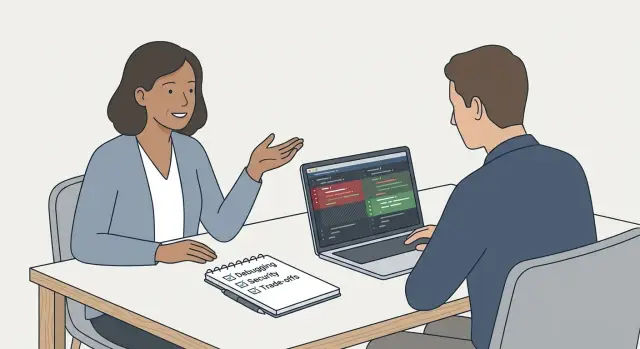
What goes wrong with AI-generated code in real projects
AI-generated apps often look great in a demo because the happy path works. The trouble starts when real users do real things: sign up twice, reset a password, paste weird input, open the app on a slow network, or try it from a different device. Many AI-built prototypes are stitched together fast, so the first edge case can break a key flow.
The common failures are easy to spot once you know where to look. Authentication is a big one: login works locally, then breaks after deployment, or roles and sessions behave inconsistently. Another classic issue is exposed secrets, like API keys sitting in client code or committed in the repo. Logic is often fragile too: a checkout total is calculated in two places, a webhook runs twice, or errors are swallowed so you get silent data corruption instead of a clear failure.
Symptoms that usually mean the code needs real repair (not minor tweaks):
- Auth and permissions feel random (users can see things they shouldn’t)
- Secrets are hard-coded or shared across environments
- Changes in one area break unrelated features
- Data handling is inconsistent (duplicates, missing updates, partial writes)
- The app works locally but fails after deployment
What you’re trying to hire for isn’t “someone to add features.” You need someone who can diagnose quickly, explain what’s happening, and apply safe fixes without creating new problems. That means reading unfamiliar code, tracing requests end-to-end, writing a few targeted tests or checks, and improving structure so the next fix is easier.
Speed matters, but speed without correctness turns prototypes into endless rework. Set expectations early: ask for an initial diagnosis first, then a repair plan with priorities. A good developer separates “stop the bleeding” fixes (security holes, broken auth, data loss) from “make it nicer” work (refactors, cleanup). If you want fast, be clear about where rough edges are acceptable and where they aren’t (security, payments, user data).
Before the interview: define the job you actually need
If you want to hire a developer to fix AI-generated code, don’t start with a generic job post. Start by writing down what “done” means for your project. Without that, interviews turn into opinion battles instead of a clear yes/no decision.
Define “done” in outcomes, not vibes. For a messy repo, “done” usually means the core flows work, basic security checks are in place, and you can deploy without surprises.
A simple target is to list what must be true when the work is finished. Keep it practical: key user journeys work end-to-end, the highest-risk paths have at least a small test safety net, secrets aren’t exposed, deployment steps are repeatable (no “works on my machine”), and the code is readable enough that another developer can continue.
Next, confirm whether the job is really “repair,” not “rebuild.” AI-generated apps can look complete but hide deep issues (tangled structure, fragile state, broken authentication). Decide what you’ll accept: a patch that stabilizes the current code, or a partial rewrite of the riskiest parts.
Also decide what kind of developer you need: someone comfortable with code they didn’t write. You can screen for this before the interview by asking them to describe their first 48 hours on a messy repository. Look for a plan that starts with diagnosis (run it, reproduce bugs, read logs), then adds safety (tests, backups, small changes), not big refactors on day one.
Finally, set expectations for how they communicate risk. You want someone who can say, “I’m not sure yet. Here’s what I’ll check next, and here’s what could change the estimate.”
Interview questions that reveal their debugging approach
You’re not hiring for cleverness. You’re hiring for a repeatable way of finding the real cause, even when the code is messy.
Ask for their first five steps after a critical bug report. You’re listening for a calm, ordered plan (gather facts, reproduce, narrow scope), not “I’d start changing things.” Strong candidates mention confirming impact, capturing exact error output, and checking recent changes.
Prompts that expose how they work:
- “A user says checkout fails. What are your first 5 steps, in order?”
- “How do you reproduce a bug when the report is vague? What details do you ask for?”
- “How do you isolate the smallest failing case, and why does that matter?”
- “Which do you reach for first: logs, breakpoints, tests, tracing? When do you switch?”
After they answer, ask them to walk through a real example. For instance: the app works locally, but in production users get logged out randomly. A good debugger talks about comparing environments, checking cookies and sessions, looking for timeouts, and adding targeted logging with a clear hypothesis.
The most revealing question is what they do when they can’t reproduce the bug. Look for answers like: improve observability (better logs, traces), create a minimal test, reduce risk with a guard or feature flag, and build a short list of hypotheses to confirm or eliminate. If they say “I’d just keep trying stuff,” that’s a red flag in fragile AI-generated codebases where one “small fix” can break three other flows.
If you want a quick reality check, ask them to explain their approach in plain language, as if they were updating a non-technical founder at the end of the day. Clear updates usually match disciplined debugging.
Questions that test how they handle uncertainty and failure
AI-generated code has a way of being confidently wrong. You need someone who can admit they guessed wrong, change direction fast, and leave the system safer than they found it.
This part of the interview isn’t about perfect answers. It’s about how they react when reality doesn’t match their first theory.
Ask for a real failure story (and make it specific)
Force detail, not a polished success story:
- “Tell me about a bug you initially misdiagnosed. What did you think it was, and what was it actually?”
- “What signal made you change your mind?”
- “What did you do first to reduce risk while you were still unsure?”
- “How did you confirm the fix, and how did you make sure it didn’t break something nearby?”
If they stay vague, follow up with: “What was the smallest experiment you ran to prove or disprove your theory?”
A realistic example: an app’s login fails “randomly.” A weak candidate blames “auth is flaky” and keeps trying new libraries. A strong candidate explains how they reproduced it, spotted token expiry or clock drift, and proved it with one or two targeted checks.
What good answers sound like
Listen for habits you can rely on. Good candidates describe a timeline (hypothesis, test, result, next step), name the evidence that changed their mind, and talk about containment (rollback plans, temporary guards). They also prevent repeats with a small test, a short root-cause note, or a monitoring alert.
If they can’t explain a mistake without blaming others, or they claim they “never misdiagnose,” that’s a warning sign. Debugging messy code is uncertainty, and the best people stay calm and methodical.
Security habits: questions that surface real practices
Security is often where “it works on my machine” turns into real risk. You want repeatable habits, not promises.
Start with authentication and sessions. AI-made apps often mix patterns (cookies, JWTs, local storage) and leave gaps.
Questions that tend to expose real practice fast:
- “When you open a new codebase, what do you check first in auth and session handling?” Listen for specifics: cookie flags (HttpOnly, Secure, SameSite), session expiry, refresh flows, and where tokens are stored.
- “Show me how you’d find exposed secrets and unsafe config.” Good answers include scanning for committed .env files and keys in the repo, plus a plan for rotation and preventing reintroduction.
- “How do you prevent SQL injection and unsafe queries here?” You want to hear parameterized queries, safe ORM patterns, and input validation. If they say “I just sanitize inputs,” ask how, exactly.
- “What’s your dependency update routine on a messy project?” Strong answers cover lockfiles, audit tools, and a test plan after upgrades.
A useful follow-up: “Explain the trade-off between speed and safety on this fix.” For example, if a prototype stores JWTs in localStorage, a solid engineer can explain why moving to HttpOnly cookies reduces XSS impact, and what that changes in the frontend.
Red flags that sound confident but vague: they can’t name concrete checks for sessions and token storage; they treat input validation as the whole SQL injection solution; they dismiss dependency risk because “it’s just a prototype”; or they avoid talking about secret rotation after a leak.
How they explain trade-offs in plain language
You’re not only hiring coding skill. You’re hiring judgment. The best candidates can tell you what they’re doing, why they’re doing it, and what you get (and give up) with each option.
A simple test: ask them to explain the same decision twice, once as if you’re a developer and once as if you’re a busy founder who just wants the risk and cost in plain words. If they can’t switch gears, you’ll struggle to make good calls together.
Quick patch vs proper refactor
Give them a real bug type (broken auth, random crashes, failing payments) and ask them to compare a fast patch with a deeper fix. You’re listening for how they describe risk, and whether they include a safety step like tests, logging, or a rollback plan.
Useful prompts:
- “If we ship a quick patch today, what can break next week?”
- “What would make you stop and say: this needs a refactor, not a patch?”
- “How would you prove the fix works without relying on hope?”
Rewrite vs repair, and how they document decisions
AI-generated code often works until it meets real traffic. Ask how they decide whether to rewrite a module or repair it. Strong candidates use signals like unclear boundaries, tangled dependencies, repeated copy-paste logic, or security risk that’s hard to contain.
Ask for a concrete example: “If the user profile module is spaghetti, what would you do in the first 48 hours?” A good plan is usually: isolate the module, add a few tests, refactor in small steps, and watch performance so you don’t create slow pages or scaling surprises.
Finally, ask how they write decisions down so non-technical people can follow. Look for short decision notes: what changed, what didn’t change (yet), risks, and next steps.
A realistic scenario to walk through during the interview
Use a small, concrete story and ask them to talk out loud.
Scenario: after an AI tool update, users can’t log in. The app shows “Invalid session” even with the right password. It worked yesterday. Now support tickets are piling up.
First, listen for the questions they ask before they touch the code. Strong candidates want basics: what changed (deploy, env vars, dependency bump), whether it affects all users or a subset, any logs or traces, what auth method you use (cookies, JWT, OAuth), and whether secrets or keys were rotated. Bonus if they ask about risk: “Are users only locked out, or are sessions being accepted incorrectly?”
Then ask them to time-box their approach. The plan should sound like a checklist, not guesswork:
- First hour: reproduce the bug, capture one failing request/response, scan recent diffs, confirm config (cookie domain, CORS, callback URL, session store).
- First day: trace the full login flow, add temporary logging around session creation and validation, write a small test that proves the failure.
- After it’s stable: refactor the fragile parts, remove hidden coupling, add monitoring, document what changed so it doesn’t happen again.
Next, ask how they confirm the fix. Good answers include a repeatable repro step, tests for success and failure cases, and a rollback plan. They should also mention preventing repeats (pinning versions, safer config checks, basic code review rules).
Finally, push on trade-offs: what would they ship now vs schedule later? You want someone who protects users today without burying you in future debt.
Common traps when interviewing for messy code repair
The biggest interview mistakes happen when the conversation stays abstract. You want details: what they look at first, what they measure, and what they do when they’re wrong.
One trap is asking questions that reward confidence, not clarity. If you ask, “Can you clean this up?” you’ll get “yes” from almost anyone. Instead, press for specifics: what signals tell them the bug is in data, auth, or state, and what evidence they’d collect before touching code.
Another common miss is over-focusing on frameworks. A candidate who talks only about rewriting in the newest stack may be avoiding the real work: reading strange code, tracing requests, and reducing risk.
Red flags to watch for:
- Their debugging plan is basically “add console logs” (no mention of repro, narrowing inputs, logs and traces).
- They dismiss tests as “later” and don’t talk about a safety net before refactors.
- They give a firm timeline without asking to see the repo, configs, and deployment setup.
- They refuse to explain decisions in plain language, or they get irritated by “why” questions.
Timelines are a special trap. Strong engineers give ranges and a plan, not a promise. “First day: reproduce and map the request flow. Day two: fix the top root causes and add tests. Then reassess” is more believable than a guaranteed turnaround without a code review.
Quick checklist: signs you found the right person
After a short review, a strong candidate can tell you what they’re looking at and why it’s failing. They don’t need perfect certainty, but they should be able to summarize the codebase in plain terms: what the app does, where the main flows are (login, payments, uploads, admin), and what looks off (missing env vars, confused data model, duplicated logic).
They also won’t jump straight into rewrites. The best pattern is: “First I’ll do a quick audit, then I’ll give you a prioritized fix list.” That list should be ranked by impact and risk, not by what’s interesting to tinker with.
Listen for production habits, not vague promises. They should naturally mention tests for broken paths, a staging environment, a rollback plan, and basic monitoring (even simple logs and alerts). They should talk about how they’ll prove the fix worked, not just how they’ll “implement” it.
Security is another quick tell. A good candidate spots risks without you feeding them clues: exposed secrets, weak auth checks, unsafe SQL building, missing input validation, or overly open CORS settings.
Also ask how they’ll run the work week to week. You want clear check-ins and deliverables you can understand, like a short list of top issues with severity, what shipped, what’s next, and what’s blocked.
Next steps: run a small trial and set a clear repair plan
Don’t jump straight into a big rewrite. With messy AI-generated code, you learn more from a small paid trial than from another hour of talking. The goal is to see how they think, how they communicate, and whether they leave the code safer than they found it.
Keep the trial small but real: one user-visible bug, one security fix, and one simple test to lock the change in. For example: “Login sometimes fails,” “remove an exposed secret from the repo and rotate it,” and “add a basic test for the login flow.” Tight scope lets you judge results in a day or two.
Before they start, agree on what “done” means and what you’ll get back. You should see a short explanation of what changed and why, notes on any config or environment updates, and a simple deploy plan that includes how to verify and how to roll back.
If you don’t have time to evaluate candidates deeply, an audit-first approach can still move things forward. FixMyMess (fixmymess.ai) focuses on diagnosing and repairing AI-generated apps from tools like Lovable, Bolt, v0, Cursor, and Replit, and starts with a free code audit so you can see concrete issues and priorities before committing to a rebuild.
FAQ
What should I define before I interview someone to fix my AI-generated app?
Start with outcomes: which user journeys must work end-to-end (login, checkout, core CRUD), what “secure enough” means for your data, and what the deployment should look like when it’s done. If you can’t describe “done” in a few sentences, the work will drift and estimates will be noise.
What’s the best way to tell if a developer can actually debug messy code?
Ask for their first five steps after a critical bug report and listen for order and evidence: reproduce, narrow scope, inspect logs, compare environments, and form a testable hypothesis. If their plan is basically “I’ll start changing code and see,” they’ll likely create new breakage in a fragile codebase.
How do I handle bug reports like “it’s broken” during the interview?
Have them explain what they ask for when the report is vague: exact steps, expected vs actual behavior, screenshots of errors, timestamps, user account details, and environment. A good answer includes how they’ll reduce the problem to a smallest failing case so the fix is targeted and safer.
Why does AI-generated code work locally but fail after deployment?
It’s usually environment mismatch or state/session issues: missing env vars, wrong callback URLs, cookies blocked by domain/SameSite settings, CORS misconfig, or differences in database and storage. The right hire will talk about comparing configs and tracing one request through the whole stack, not rewriting the auth system immediately.
Which security questions quickly reveal if they’re strong on authentication?
Ask where they look first: token storage, cookie flags (HttpOnly, Secure, SameSite), session expiration and refresh logic, and role checks on the server. You want someone who can explain how they’d prove a permissions bug and how they’d prevent regressions with a small test or check.
What should a developer do if they find exposed API keys or secrets in the repo?
They should describe finding the secret, removing it from client code and history if needed, rotating the key, and adding guardrails so it doesn’t come back (config validation, secret scanning, safer environment handling). If they only say “I’ll delete it,” that’s not enough because leaked keys can stay usable.
How do I check whether they’ll prevent SQL injection instead of patching around it?
Look for “parameterized queries or safe ORM patterns” plus input validation and least-privilege database access. If they rely on “sanitizing strings” as the main defense, they may miss whole classes of injection and authorization issues.
How should they prioritize fixes: quick patches vs deeper refactors?
A disciplined repair plan starts with “stop the bleeding” items like auth breakage, data corruption, and security holes, then moves to structure improvements that reduce future risk. If they jump straight to broad refactors without a safety net, you’ll often get a cleaner-looking repo that still fails in production.
What should good communication look like during a repair project?
Ask them to give an update as if you’re not technical: what they found, what they proved, what they changed today, what risk remains, and what’s next. Clear, calm updates usually correlate with careful debugging and fewer surprise regressions.
What’s a good paid trial task for someone fixing AI-generated code?
A good trial is small and real: one user-visible bug fix, one security fix, and one basic test or check that locks the behavior in. If you want to skip candidate shopping, a service like FixMyMess can start with a free code audit and a prioritized repair plan, then complete the highest-impact fixes quickly with human verification.