Marketplace MVP trust features: profiles, messaging, disputes
Learn which marketplace MVP trust features to ship first: profiles, messaging rules, disputes, and reviews, plus simple policies and checks to reduce fraud early.
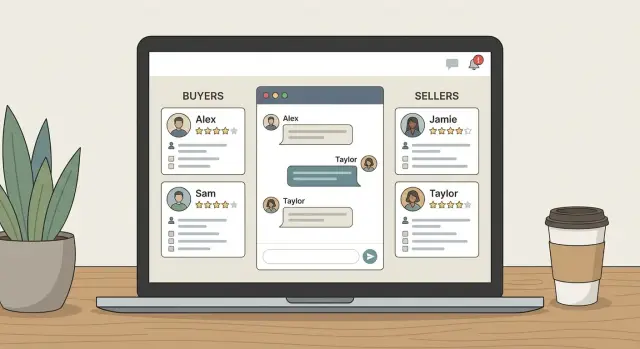
What trust looks like in a marketplace MVP
Trust in a marketplace MVP isn’t a vibe. It’s the small, practical details that prevent bad matches, scams, and the “what happens now?” feeling when two strangers try to make a deal.
If you’re choosing between more features and safer transactions, pick safety. Early on, one bad experience can cost you more users than five missing features. The goal isn’t perfection. It’s “safe enough to transact,” with clear rules that honest users can move through quickly while risky behavior gets slowed down or blocked.
A simple test for minimum trust:
- Can a user tell who they’re dealing with?
- Can they communicate without getting tricked?
- Can they get help when something goes wrong?
- Can they leave feedback afterward?
A practical rule for what to build now vs later: build now when it prevents real harm (money loss, fraud, harassment, chargebacks) or removes confusion at a key step (booking, payment, delivery, cancellation). Build later when it’s mostly comfort (badges, long bios, feeds) or when you can’t enforce it (for example, “verified” labels with no real checks).
Start with a clear scope and risk map
Trust features only work if your marketplace is clear about what a transaction is. Before you build profiles, messaging, disputes, or reviews, decide what you’re actually selling: services (a job done), rentals (an item returned), goods (an item shipped), or bookings (time reserved).
Write down the two sides in plain words (buyer and seller, client and provider, host and guest). Then define what “successful” means. For a service, it might be “work delivered and accepted.” For a rental, it might be “item picked up, returned, and confirmed.” That definition becomes the backbone of your trust rules.
Keep your scope note short:
- Marketplace model (services, rentals, goods, or bookings)
- The two sides and what each side must do
- The single event that marks “complete” (accepted delivery, confirmed return, paid booking, and so on)
Next, make a basic risk map. You’re looking for the moments where users can get scammed, confused, or angry, and adding small guardrails in those spots.
Most early marketplaces see risk in the same places: signup (fake or duplicate accounts), first messages (off-platform payment requests, phishing, harassment), payment (chargebacks, broken checkout), delivery or completion (no-shows, “not as described”), and post-transaction (revenge reviews, disputes used as threats).
Finally, write one sentence about what you won’t support at launch. Example: “We do not support partial refunds, split payments, or disputes for offline transactions.” That single line cuts weeks of edge cases and makes your rules easier to explain and enforce.
Profiles: the minimum you need, and what to avoid
Profiles are your first trust test. If a user can’t quickly answer “Who is this?” and “Are they a fit?”, they either leave or take the conversation off-platform.
For an MVP, keep public profiles small and useful: display name, a clear photo, rough location (city/region), and a short bio (2-3 lines). Add one “proof” field that matches your marketplace, such as services offered, categories, or a typical price range. That’s usually enough for someone to decide whether to message.
Role-specific info matters. Providers need clear “what I do” signals (service type, availability, a human-sounding about). Buyers can stay lighter (who they are, what they’re looking for). If showing a buyer’s budget publicly attracts spam, keep it private.
Verification is where many MVPs overreach. Start with email verification and rate limits. Add phone verification only if spam is common. Consider ID checks only when the risk is real (high-value services, regulated work, minors, in-person meetings). If you can’t handle edge cases, don’t collect IDs yet.
Default to privacy. Make public: name, photo, approximate location, bio, and aggregate ratings. Keep private by default: email, phone, exact address, and payment details. Make it obvious what others can see.
Avoid long forms, social-style follow features, and badges you can’t enforce. Fake trust signals backfire faster than having fewer fields.
Messaging rules that reduce scams without killing conversion
Messaging is where trust breaks first. Buyers and sellers need enough freedom to coordinate, without turning scams and harassment into “normal.” When it’s working, it should feel invisible.
Start by allowing what users truly need: plain text, images for proof, and links only when they add real value (like a product spec). Contact details are the tricky part. Many scams start with “Let’s move to WhatsApp” or “Pay me directly,” so treat phone numbers and emails as controlled content.
Set a few rules early and show them inside chat when someone tries to break them:
- No off-platform payment requests
- No harassment or hate speech
- No sharing personal info (doxxing)
- No sharing passwords, one-time codes, or secrets
- Keep communication about the specific order
Enforcement works best when it’s targeted. Mask phone numbers and email-like text by default, and allow sharing only after an order is placed (or after both sides pass basic verification). For links, block known risky patterns and flag shortened URLs for review. Simple filters are easy to bypass if you don’t also log and review suspicious attempts.
Keep moderation lightweight and predictable: a “Report” button in every chat, a small set of reason codes (spam, off-platform payment, harassment, unsafe link, other), an auto-acknowledgment with a response window, and temporary limits for repeat offenders (cooldowns, link disabled). Leave room for human review on edge cases.
A simple example: a seller drops a phone number in the first message. The number gets masked, the seller sees a short warning, and the buyer can still keep the conversation going and complete checkout without leaving your platform.
Disputes: a lightweight process users can understand
Disputes are important, but they don’t need to be complicated. Users mainly want two things: a policy they can read in a minute, and a process that feels fair.
Start with a simple dispute policy. Define what counts (non-delivery, item not as described, damaged goods, no-show service) and what doesn’t (buyer’s remorse, changing your mind after work started). Say what evidence you accept: order details, message screenshots, photos, delivery tracking, receipts. Add timelines so people know what to expect: when a case must be opened, how long each side has to respond, and when you decide.
Keep the flow consistent:
- Open a case from the order page and pick a reason
- Upload proof (2-5 items) and write a short summary
- The other side responds within a set window
- You request one more piece of info if needed
- Decision and outcome are posted, then the case closes
Early on, manual review is usually safer than trying to automate judgment. Rules-based outcomes can work for very clear situations (no tracking update after X days, seller never responded within Y hours). Everything else should go to a human, even if it’s a quick check.
For messy cases you can’t verify, don’t leave people hanging. Use a small set of outcomes (refund, credit, partial refund, split decision) and explain the “why” in plain language. A short explanation reduces repeat disputes and angry support threads.
Reviews and ratings that help users choose
Reviews build confidence fast, but only if they’re tied to real transactions. Set a clear rule for when a review can be left, such as after a job is marked complete or after delivery is confirmed.
Fairness matters more than fancy UI. If both sides can review, you reduce one-sided stories. Two MVP-friendly patterns are delayed reveal (reviews show only after both submit) or a short timer (for example, 7 days) where reviews go public when the window closes. If your marketplace is one-directional, single-sided reviews can work, but make it obvious who is reviewing whom.
Treat reviews as part of the transaction, not part of the profile. Allow one review per completed transaction, keep a short edit window for typos, and add basic anti-retaliation rules. Delayed reveal helps because people can’t “answer back” after seeing the other rating.
What you show publicly should help decisions quickly: average rating and count, a short text snippet (with a character limit), a few tags like “On time” or “Good communication,” recent activity, and a verified-transaction marker.
Common traps when building trust features fast with AI tools
When you build quickly with AI tools, trust features can look finished but behave badly under pressure. The aim isn’t perfection. It’s preventing the most common ways people get hurt or feel tricked.
Name your failure modes before you ship. Early marketplaces often run into the same problems: fake accounts that disappear after a scam, review farming, chargebacks after off-platform deals, and bait-and-switch listings that change after payment.
The most expensive shortcut is skipping the paper trail. If your MVP has messaging, payments, cancellations, or disputes, you need records that answer: who did what, when, and from which account. Without that, every dispute becomes a guessing game, and you can’t spot repeat offenders.
A few shortcuts that usually backfire:
- No reporting flow
- Unclear policies on cancellations, refunds, and off-platform contact
- No audit trail for message edits, listing edits, and status changes
- Forcing ID checks on everyone from day one
- Letting contact info through immediately
A small example: a seller asks a buyer to “text me for a discount” in the first message. If you allow that with no guardrails, you lose visibility and invite chargebacks. A simple filter plus an in-chat policy reminder often prevents it.
Behind-the-scenes basics: logs, permissions, and security
Trust features only work if you can prove what happened when something goes wrong. That means a few boring foundations users never see.
Build an audit trail you can actually use
Keep a simple, searchable record of key events. You’ll rely on it during disputes, chargebacks, and moderation.
Log the essentials: timestamps for messages, offers, payments, and status changes; message history (including edits and deletes); attachment metadata and who uploaded it; dispute actions; and review history with reasons for any removals.
Don’t over-collect personal data. Log actions, not private details.
Permissions, rate limits, and security basics
Decide upfront what each role can see and do. Users should be able to delete their own drafts, but they shouldn’t be able to erase history that affects someone else, especially during a dispute. Admin actions should be logged too.
Add simple rate limits to cut spam without hurting normal use: signup and login attempts, messages per minute (especially for new accounts), review submissions and edits, dispute openings.
Cover security basics that break many AI-built prototypes: keep secrets out of the frontend and repositories, validate all inputs (including filenames and URLs), and use safe queries to avoid SQL injection. A realistic failure looks like this: someone sends 200 messages in 2 minutes, drops a malicious link, then deletes the thread. With logs, permissions, and limits, you can stop the flood and still see what happened.
Step-by-step: ship trust features in a sensible order
Write the simplest user journey on one page: sign up, set up a profile, browse, message, transact, leave a review. For each step, add one trust touchpoint that reduces risk without adding a lot of friction.
Put trust where it matters: a warning before sharing contact info, a confirmation before paying, a clear “Report” button, a short dispute form.
A sensible build order:
- Profiles first (identity basics and privacy defaults)
- Messaging rules next (masking, rate limits, reporting)
- Disputes after that (structured flow, deadlines, outcomes)
- Reviews last (only after completed transactions)
Leave reviews for last because they depend on everything else. You need “who did what, when” to make ratings meaningful and to reduce fake feedback.
Test with five real scenarios before launch using two test accounts and a fresh database each time: block contact details in early messages, confirm reports are logged, open a dispute within the allowed window, block reviews without completion, and verify edits/flags still leave a clear audit trail.
Quick checklist before you launch
Trust features break in small, hidden ways. Before you open the marketplace to real users, run a short smoke test on the most common failure points.
10-minute launch smoke test
Check profiles (missing photo, inconsistent locations, copy-paste bios), messaging (blocked words, phone numbers, off-platform bait, reports that actually submit), disputes (evidence upload, correct transaction binding, clear status updates), and reviews (only after completion, one per transaction, edit rules). Then test edge cases like bans, name changes mid-dispute, and account deletion. Messages, disputes, and reviews should remain consistent.
If any of these checks are hard to verify, it usually means you’re missing basic logs or permissions.
A realistic example scenario from first message to review
A startup founder posts a project in a services marketplace: “Landing page redesign, 5 sections, new hero, export to Figma.” A designer replies, they agree on $600, and the founder pays into escrow. The first milestone is due in 3 days.
On day two, the founder messages: “Can you also make it responsive for mobile and add two extra sections?” The designer says yes, sends a preview file, and asks to confirm the added scope. The founder reacts with “Looks good” but doesn’t answer the scope question. The designer delivers the original 5-section design on time. The founder complains: “This is incomplete, I asked for mobile and two extra sections,” and requests a refund.
This is where trust features matter because the platform can point to evidence instead of opinions. The useful evidence is simple and mostly automatic: the agreed scope summary, message timestamps showing when extra requests appeared, file uploads and versions, a due date and “Delivered” event, and any explicit “Approved” or “Needs changes” action.
The dispute flow can stay lightweight. The founder opens a case, picks “scope mismatch,” and doesn’t need to upload much because the chat and files are already attached. The designer replies and highlights the scope-confirmation question.
A simple rule resolves it without drama: if extra scope wasn’t confirmed, release payment for the original milestone and invite the founder to create a paid add-on for mobile and extra sections.
Collect reviews after the outcome, not during the argument. Asking for reviews 24 hours after the dispute closes, and using delayed reveal or a short window, reduces retaliation.
Next steps: stabilize your AI-built marketplace MVP
Once people can message, pay, or leave reviews, you need proof you can investigate what happened. If you can’t trace actions, you can’t resolve disputes fairly, and trust starts to feel random.
Common warning signs:
- Disputes pile up and you can’t verify messages, timestamps, or who clicked what
- Spam or scams keep getting through and you can’t enforce simple messaging rules
- Users report login or email problems and you can’t reproduce them
- Admin actions are manual, inconsistent, or not logged
- You’re unsure where sensitive data is stored or who can access it
If you inherited an AI-generated codebase and the trust flows look fine in the UI but don’t hold up in production, FixMyMess (fixmymess.ai) focuses on diagnosing and repairing the foundations: auth, messaging logic, security hardening, refactoring, and deployment preparation. They also offer a free code audit to surface the issues before you scale.
FAQ
What’s the minimum “trust” I need before launching a marketplace MVP?
Start by making transactions feel safe enough to complete. Cover identity basics, safe messaging, a clear payment/completion step, and a way to get help if something goes wrong. Fancy profile polish can wait.
How do I decide what a “successful transaction” is in my marketplace?
Pick one clear transaction type and define what “done” means in one sentence, like “service delivered and accepted” or “item returned and confirmed.” That definition drives your rules for messaging, payments, disputes, and reviews.
Where do most early marketplace scams or failures happen?
Map the riskiest moments: signup, first messages, payment, delivery/completion, and post-transaction. Add small guardrails where real harm happens, like fraud, harassment, chargebacks, or confusing cancellations.
What should I put on profiles for an MVP (and what should stay private)?
Keep profiles short and decision-friendly: name, photo, rough location, a 2–3 line bio, and one proof field that matches your marketplace (category, services offered, or typical price range). Hide private details like email, phone, and exact address by default.
Do I need ID verification or phone verification on day one?
Default to email verification and rate limits first. Add phone verification only if spam is a real problem, and reserve ID checks for high-risk cases like high-value, regulated, or in-person transactions. If you can’t handle edge cases, don’t collect IDs yet.
How do I prevent off-platform payment scams without killing conversions?
Allow what users need to coordinate, but slow down risky behavior early. Mask phone numbers and emails by default, warn in-chat when someone tries to move payment off-platform, and let contact sharing unlock only after an order is placed or basic checks are passed.
What’s a lightweight dispute process that users will actually trust?
Make disputes simple and predictable: clear reasons, what evidence you accept, and timelines for responses and decisions. Start with manual review for anything unclear, and explain outcomes in plain language so users understand what happened.
How do I set up reviews and ratings without creating retaliation and fake reviews?
Only allow reviews tied to completed transactions, and keep it to one review per order. Use delayed reveal or a short review window so people can’t retaliate after seeing the other person’s rating.
What “behind-the-scenes” foundations make trust features work?
You need a basic audit trail of who did what and when, especially for messages, listing changes, payments, status updates, disputes, and admin actions. Without logs and permissions, every dispute turns into guesswork and repeat abusers are hard to spot.
When should I get help fixing an AI-built marketplace MVP instead of adding more trust features?
Watch for UI that looks finished but breaks under real usage, like exposed secrets, weak auth, missing logs, or messaging that can be edited/deleted without a trace. If you inherited an AI-generated codebase and the trust flows aren’t reliable in production, FixMyMess can diagnose and repair the foundations quickly, and you can start with a free code audit before committing.