SaaS remediation cost for a small AI-built app
A practical SaaS remediation cost model covering diagnosis, security, logic, refactoring, testing, deployment, and quote-changing findings.
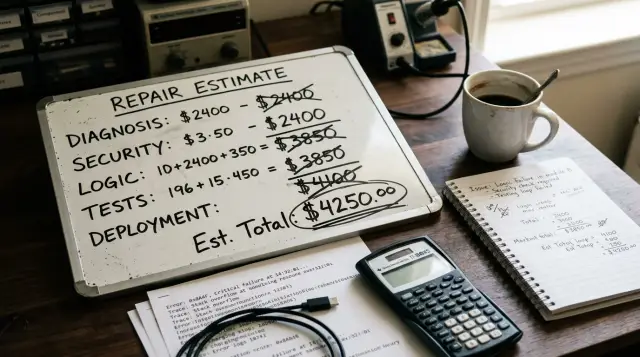
A fixed price for repairing a small AI-built SaaS should follow a paid or clearly bounded diagnosis, not a glance at the repository and a guess. For most small products, I build the quote from six work packages: diagnosis, security repair, logic repair, selective refactoring, testing, and deployment preparation. The price is credible only when each package names its evidence, assumptions, and completion test.
The uncomfortable part is that a neat prototype can hide expensive failures. A working login screen says nothing about tenant isolation. A successful test payment says little about webhook replay, entitlement changes, or refunds. The useful question is not how many screens the app has. It is how many business promises cross trust boundaries, write data, call paid services, or depend on production configuration.
The dollar ranges below are planning bands in USD for scoping a small app, not published market averages. They assume one web application, one main database, a conventional managed deployment target, and a codebase that can run locally. Use the method to build a quote from evidence. Do not paste the totals onto a project with different facts.
Fixed price starts after a bounded diagnosis
A contractor can responsibly fix the price only after reproducing the app, tracing its main workflows, and recording the unknowns that remain. Before that point, a fixed number is either padded to cover fear or too low to survive contact with the code.
For a small SaaS, diagnosis usually means 8 to 20 focused engineering hours. A practical planning band is $1,000 to $3,000 when the repository runs with ordinary setup and the owner can explain the intended behavior. The band moves up when nobody controls the deployment account, migrations have no reliable order, the database schema differs from the repository, or essential behavior lives in a visual builder outside version control.
The deliverable should be more than a list of lint errors. I expect a route and workflow map, an inventory of data stores and external services, a secrets review, a dependency and build check, production log samples, and a ranked finding register. Each finding needs four fields: observable failure, likely cause, affected workflow, and proposed proof of repair. That register becomes the estimate.
Diagnosis also needs a stopping rule. The reviewer should inspect every critical workflow but does not need to explain every generated component before pricing a contained repair. State which routes were exercised, which roles were used, how much production evidence was available, and which areas were sampled. If the app has an unused reporting module or an unfinished administrator screen, either include it in the scope or mark it outside the reviewed boundary. Silence is not an assumption.
A developer can collect an initial evidence packet with ordinary repository commands:
$ git status -s
 M src/auth/session.ts
?? notes/production-errors.txt

$ git ls-files | sed -n '1,12p'
.env.example
package.json
src/auth/session.ts
src/billing/webhook.ts
...

$ git log -1
commit a1b2c3d
Author: Example Developer
Date: Mon Jul 20 10:14:00 2026 +0000
    fix checkout callback
The exact filenames do not matter. The output establishes which commit was reviewed, whether uncommitted work exists, and where security-sensitive code probably sits. Add sanitized production errors, the deployment settings, database migration status, and test commands. Never copy live secrets into the packet.
I reject the popular offer to diagnose for free while also promising a binding repair total. A short free triage can decide whether the project is a plausible fit, but a binding quote requires real investigation. When a provider absorbs that work, the cost does not disappear. It returns as a padded estimate, a shallow review, or change orders that should have been predictable.
Price work by risk, not by file count
The estimate should price observable responsibilities and risk, because lines of code have almost no stable relationship to repair effort. Generated projects often contain thousands of repetitive lines around one broken authorization assumption. The dangerous change may be six lines, while proving it safe takes two days.
I split findings into defects, design gaps, and operational gaps. A defect violates behavior the system already intends, such as a checkout handler that writes the wrong plan. A design gap means the intended behavior is missing or contradictory, such as no rule for what happens when a subscription expires. An operational gap appears only outside a developer laptop, such as missing environment variables, no migration command, or a host that kills long-running jobs. Those categories need different pricing. Defects can often be bounded from code. Design gaps consume product decisions. Operational gaps depend on access and the target environment.
A useful estimate worksheet has one row per work package. Diagnosis at $1,000 to $3,000 ends with reproduction notes and a ranked finding register. Security repair at $1,500 to $6,000 ends with abuse tests and control-specific verification. Logic repair at $1,500 to $5,000 ends with passing workflow acceptance cases.
Selective refactoring at $1,000 to $4,000 must reduce a named change surface while preserving behavior. Testing at $1,500 to $4,000 supplies an automated critical-path suite and test report. Deployment preparation at $750 to $2,500 supplies a repeatable staging or production release and rollback notes. These remain planning bands until diagnosis ties them to findings.
Adding every maximum produces a scary number, but that is not how the worksheet should be used. Some packages overlap. A security repair may include the tests that prove authorization, and a logic repair may remove the duplication that would otherwise need refactoring. The quote should state those overlaps so the buyer does not pay twice.
The provider will still estimate labor internally. A sound fixed amount usually combines the expected engineering time, review time, coordination, and a reserve for ordinary variation inside the known scope. That reserve is not a license to conceal the arithmetic. Ask for the work packages and their acceptance evidence, not an employee-by-employee timesheet. The provider owns the risk that a named repair takes somewhat longer; the buyer owns changes to the facts and decisions supplied for the estimate.
Sequence affects the total as well. Security and logic repairs should precede broad test automation, because tests written around incorrect behavior become rework. Deployment discovery should happen early enough to expose platform limits, even if the release occurs last. A quote that schedules six independent phases may count the same setup and code reading six times. One that treats everything as one task may hide where the money goes.
For a genuinely small app with contained findings, the combined fixed price often lands around $7,000 to $18,000 under these assumptions. Treat that as a computed planning envelope, not a promise or a benchmark. A $3,000 repair can be sensible when the failure is isolated and the deployment already works. A $30,000 quote can also be sensible when the word "small" describes the interface but not the permissions, billing states, data cleanup, or release risk.
Security scope follows trust boundaries
Security work should be estimated from the app's trust boundaries and data actions, not from a generic promise to "harden" the code. That word hides scope. The quote should name the controls and how someone will test them.
Start with authentication, session handling, authorization, input handling, secrets, and data exposure. Then trace every place the app crosses into another system: payment webhooks, email links, file storage, background jobs, administrative endpoints, analytics, and AI model calls. Each boundary adds failure modes that a happy-path browser test will miss.
OWASP's Application Security Verification Standard gives teams a basis for testing web application controls and a requirements list for secure development. I use it as a coverage index, not as a claim that every small SaaS needs every requirement. Select the applicable controls, record the chosen version, and attach specific tests. That approach is far more honest than selling an undefined "OWASP review."
Security findings that commonly expand the quote include:
- authorization enforced only in the interface, with no server-side ownership check;
- exposed credentials that require rotation, history review, and deployment changes;
- string-built database queries on user-controlled values;
- shared administrative routes with no role model or audit trail;
- public file URLs where the product promise assumes private files.
Severity and repair effort are separate columns. A severe exposed-secret finding can be cheap to change when the credential was a disabled test value, while a moderate authorization defect can be expensive when it appears across dozens of handlers and old records. Quote labor from the affected surface and required proof. Use severity to decide priority, containment, and release conditions. Mixing the two encourages a provider to charge by fear.
Consider a two-tenant app where the browser hides records that do not belong to the signed-in account. The API accepts /projects/123, loads project 123, and returns it without checking the tenant identifier. Fixing the query may take minutes. Finding every sibling endpoint, defining administrator behavior, repairing background jobs, adding negative tests, and checking whether data was exposed is the actual work. A quote that prices one line has misunderstood the failure.
NIST's Secure Software Development Framework says teams should address root causes so vulnerabilities do not recur. Applied to remediation, that means a leaked key is not closed when someone deletes it from the current file. The work can include revocation, replacement, repository history review, deployment configuration, least-privilege adjustment, and a test that prevents another committed secret. Price the chain or exclude parts of it explicitly.
Logic repair is a product decision before it is code
Logic repair can be fixed-price only when the owner can state the expected result for each important workflow. Generated code often implements a plausible path, but plausible is not the same as agreed.
Billing makes this obvious. Suppose checkout creates a paid account, but the code has no consistent response for a failed renewal, refund, charge dispute, plan downgrade, delayed webhook, or duplicate event. A developer cannot "fix billing" from taste. The owner must decide when access changes, which data remains available, and whether an administrator can override the state.
I turn each workflow into a small decision list before pricing it:
- A trial with valid payment confirmed becomes active, and paid features become available once.
- An active account that receives a duplicate confirmation stays active without duplicate credit or email.
- An active account with a failed renewal enters the grace or restricted state chosen by policy and shows a clear status.
- An active account with a confirmed refund enters the written post-refund state, and access follows that policy.
The table exposes missing product policy without pretending it is an engineering defect. If the owner supplies those decisions during diagnosis, the developer can price implementation and tests. If decisions will happen during the repair, the quote needs a decision allowance, an hourly discovery line, or an explicit change mechanism.
For a small app with two to four damaged core workflows, $1,500 to $5,000 is a reasonable planning band. The lower end fits localized state or validation errors with clear acceptance cases. The upper end fits behavior spread across browser state, API handlers, database triggers, and external callbacks. Add more when existing production data must be corrected, because a safe backfill needs dry runs, counts, backups, idempotency, and a reversal plan.
Data correction should appear as its own quantity even when the code repair is fixed. The estimate can define a known table, date range, and maximum record count, then price a repeatable script and verification query. If the real population exceeds that boundary, the parties already know what changed. Never accept a promise to "clean the database" without a selection rule and before-and-after counts.
Do not confuse a working demonstration with a correct state machine. Click tests usually prove one order of events. Production sends events late, twice, and sometimes after an administrator has already changed the record. A fixed quote should say which event orders and failure states the tests cover.
Refactoring needs a repair reason
Refactoring belongs in a remediation quote only when it reduces the risk or cost of a named repair. A broad cleanup mandate gives the developer unlimited taste and gives the buyer no objective finish line.
Useful refactoring has a direct connection to the findings. Extracting one authorization function can prevent five endpoints from implementing ownership differently. Replacing three conflicting subscription flags with one defined status model can make billing repair testable. Separating environment configuration from code can stop staging values from reaching production.
The Twelve-Factor App argues that deploy-specific configuration, including credentials and resource handles, belongs in environment variables rather than constants in code. I agree with the separation, but moving strings is not enough. The remediation also needs startup validation, a documented variable list, safe defaults where they make sense, and a clear failure when a required value is absent. Otherwise the app becomes cleaner on paper and still fails during deployment.
A targeted refactoring package for a small codebase may take 8 to 30 hours, often $1,000 to $4,000 in the planning model used here. Define it by boundary and result: "centralize authorization for project and invoice routes, preserve existing allowed behavior, and pass the access matrix." Avoid "improve architecture" or "clean spaghetti code." Nobody can prove those phrases complete.
I also push back on the automatic rewrite recommendation. Rewrites appeal to developers because blank files remove the need to understand awkward code. They also discard working edge behavior, delay feedback, and create a second system whose unknowns have not appeared yet. Rewrite a component when its contract is understood and repair would cost more than replacement. Rewrite the whole app only when diagnosis shows that the current structure cannot preserve the required behavior safely, and price data migration and cutover as first-class work.
Refactoring should never become a tax charged because an AI tool produced the code. Charge for the work that changes the outcome. Leave harmless ugliness alone.
Testing proves the quote is finished
Testing needs its own scope because "the app works now" is not evidence that the remediation is complete. The test plan should map directly to the finding register and the owner's critical workflows.
For a small SaaS, I usually want a narrow automated suite around authentication, tenant access, the primary create or edit workflow, billing state changes, and any destructive administrative action. Add integration tests at boundaries where mocks would hide the failure. A mocked payment callback cannot prove signature verification. An in-memory database may not reproduce the constraints or query behavior of the production database.
The Twelve-Factor App recommends keeping development and production as similar as possible. That advice matters here because generated prototypes often use one database locally and another in production, or rely on browser-only testing against a permissive development configuration. Test parity does not require a clone of production. It requires the same important service types, migration path, runtime version, and configuration rules.
A compact acceptance record can look like this:
AC-07 Cross-tenant project read
Given: user A belongs to tenant A; project B belongs to tenant B
When:  user A requests the project B identifier through the API
Then:  response is 404; no project fields are returned; denial is logged
Evidence: integration test authz.projects.spec, run 184, passed
This record does three jobs. It tells the developer what to build, gives the buyer a reviewable finish line, and limits arguments about whether a screenshot counts as proof. For quotes in this size range, $1,500 to $4,000 often covers test setup and critical-path cases. The price rises when the code has no test seams, external services lack safe test modes, or asynchronous work needs deterministic control.
Manual checks still matter for visual behavior and deployment smoke tests. They should complement repeatable tests, not replace them. If a provider removes testing to make the quote cheaper, the buyer is purchasing changed code with the verification deferred to users.
Test ownership matters after handoff. The quote should identify which commands run locally and in continuous integration, which test data they create, and which external credentials they require. Flaky tests are not useful acceptance evidence. If a boundary cannot be automated within the budget, name the manual procedure, expected result, and person responsible instead of quietly omitting the check.
Deployment is part of remediation
Deployment preparation should be priced as engineering work, because a repair that exists only on a laptop has not repaired the product. The scope needs a target environment, required access, release steps, migration behavior, health checks, and rollback conditions.
For a conventional managed host, $750 to $2,500 may cover configuration review, a repeatable build, migration wiring, staging release, smoke tests, logging checks, and a short runbook. That band assumes the accounts exist and the platform can run the chosen stack. Missing ownership, incompatible runtime limits, network restrictions, or an undeclared background worker can change the job.
Build, release, and run are separate stages in the Twelve-Factor model. That distinction catches a common AI-built app failure: a build script reaches a live database, a migration runs every time a process starts, or runtime configuration gets baked into a public browser bundle. Remediation should put each action in the right stage and prove that a fresh release can be created from the reviewed commit.
The deployment proof should record the commit, migration version, configuration checklist, smoke-test result, and rollback point. If a schema migration changes existing rows, require a backup or recovery method and a dry-run count. If the platform cannot roll back the database with the application, the runbook must explain the forward repair path.
FixMyMess combines AI-assisted tools with human verification for code diagnosis, logic repair, security hardening, refactoring, and deployment preparation, and its free code audit can establish whether a project needs a contained repair or a larger rebuild. That is useful at the triage boundary, but the resulting fixed quote still needs the assumptions and acceptance evidence described here.
Do not let "deployment included" mean that someone presses a button once. The deliverable is a release another competent person can understand and repeat.
Some findings must reopen the quote
A good fixed-price agreement names the discoveries that can change the quote, because fixed price transfers ordinary execution risk, not every concealed condition. The trigger must be factual and reviewable, not "the code was worse than expected."
I use triggers such as these:
- a required repository, service account, or production environment is unavailable after the agreed access date;
- the production schema or runtime materially differs from the diagnosed version;
- investigation finds confirmed cross-tenant exposure, active credential misuse, or a required incident review;
- the owner changes an acceptance rule, adds a workflow, or chooses a different deployment target;
- data repair affects records or systems outside the sampled and documented boundary.
Each trigger should say what happens next. The provider pauses the affected package, shows the evidence, explains the options, and prices only the delta. Unaffected work can continue when it is safe. The buyer should be able to reject the change and receive the completed work and notes paid for so far.
Ordinary variation stays with the provider. If the quote includes repairing five named endpoints, discovering that one handler is longer than expected is not a change. If the diagnosed repository points to one database and production turns out to depend on an undocumented second database with conflicting records, it probably is. The agreement should distinguish estimation error from changed facts.
Security discoveries deserve special handling. A suspected exposure can create preservation, rotation, notification, or legal questions outside the original coding scope. The developer should not bury that work inside a small repair allowance, and should not claim authority to decide the organization's response. The quote can cover containment code while a separate owner coordinates incident obligations.
A cap can make uncertain work buyable. For example, authorize up to eight hours to characterize an unexpected data problem, then require a new decision. That buys evidence rather than an open-ended repair.
A defensible quote shows its arithmetic
The final quote should show packages, assumptions, exclusions, acceptance tests, schedule dependencies, and a total, so a non-technical owner can compare offers without guessing what "production ready" means. A one-line total hides too much.
Consider a diagnosed app with broken tenant authorization on four API routes, inconsistent subscription state, committed test credentials that were never used in production, duplicated configuration, almost no automated tests, and a working managed deployment. An illustrative quote might assign:
- $1,500 to diagnosis and the finding register;
- $3,200 to authorization and secrets repair;
- $2,800 to subscription logic repair;
- $1,400 to refactoring required by those repairs;
- $3,800 to critical workflow tests, the staging release, and the runbook.
The fixed total is $12,700.
That total is defensible only with its assumptions. The credentials are confirmed as non-production and still get removed and replaced. The owner supplies billing decisions within two business days. The existing host remains the target. The quote excludes historical incident investigation, a new visual design, feature additions, and correction of production data beyond a stated sample.
Payment structure should follow evidence. A deposit reserves the work, a midpoint can follow demonstrated repairs in staging, and final payment can follow the acceptance record and handoff. The exact percentages are commercial terms, but the milestones should describe observable results instead of elapsed days.
Compare exclusions as carefully as totals. One bid may include tax, project management, a staging environment, and thirty days of defect correction, while another stops at a pull request. The brief here does not assume any warranty period, so a buyer should ask what happens when an included acceptance case fails after delivery. A correction window should cover departures from the agreed behavior, not new requirements or unrelated service outages.
Schedule promises need the same discipline. Engineering effort is not calendar duration when the provider waits for account access, policy decisions, or a third-party review. The quote should list owner response times and explain whether delays move the delivery date. A short delivery promise with no access assumptions is marketing, not planning.
Ask every bidder for the same five answers: which commit and environment did you inspect, which findings are included, what proves each repair, what facts can change the price, and what will I own at handoff? A cheaper bid that cannot answer them is not comparable. It has moved cost into ambiguity.
Fixed price works when diagnosis turns uncertainty into named assumptions and tests. If a provider will not show the arithmetic, buy a bounded diagnostic first. If the evidence shows that repair is the wrong choice, paying to learn that early is cheaper than forcing a tidy quote onto an untidy system.
FAQ
How much does it cost to repair a small AI-built SaaS?
Under the assumptions in this article, a contained project often fits a $7,000 to $18,000 planning envelope. That is not a market rate or a promise. Authentication, billing, data repair, and deployment facts can move the total quickly.
Can a developer quote remediation before seeing the code?
They can offer a rough range or price a bounded diagnosis. A binding repair price before reproducing the app usually contains a large risk premium or leaves room for predictable change orders.
Should the initial code audit be free?
A free triage can decide whether the app is a fit and identify obvious risk. The investigation needed for a binding scope has real engineering value, so either price it or state exactly how limited the free audit is.
What makes security remediation expensive?
The code edit is often the smallest part. Complete security repair can require endpoint discovery, credential rotation, access tests, data exposure review, deployment changes, and proof that the root cause cannot recur.
Is rewriting an AI-generated app cheaper than fixing it?
Sometimes, but not by default. A rewrite makes sense when a diagnosed component has a clear contract and replacement costs less than safe repair. A full rewrite also needs migration, acceptance tests, and cutover planning.
How should billing bugs be estimated?
Write the expected state for successful payments, failures, refunds, disputes, plan changes, and duplicate or delayed events. Once those product decisions are explicit, estimate the handlers, data changes, and tests that implement them.
What testing belongs in a fixed-price repair?
At minimum, test every named finding and the workflows that protect access, money, or destructive actions. Use integration tests where mocks would hide database, webhook, session, or deployment behavior.
Does remediation include deploying the repaired app?
Only if the quote names the target environment and release evidence. Look for configuration checks, migration steps, a deployed commit, smoke tests, logging checks, rollback conditions, and a runbook.
When is a change order fair on a fixed-price project?
A change is fair when a documented assumption proves false or the owner changes scope. A provider's ordinary underestimation is not a new fact and should not automatically become the buyer's bill.
What should I receive when remediation is complete?
You should receive the repaired code, finding register, test results, deployment notes, configuration requirements, and any remaining-risk list. The handoff should identify the reviewed commit and let another competent developer reproduce the release.