Vercel vs Railway vs Render comes down to rollback risk
Vercel vs Railway vs Render compared for safe Next.js rollback, including previews, migrations, secrets, and recovery after one realistic failure.
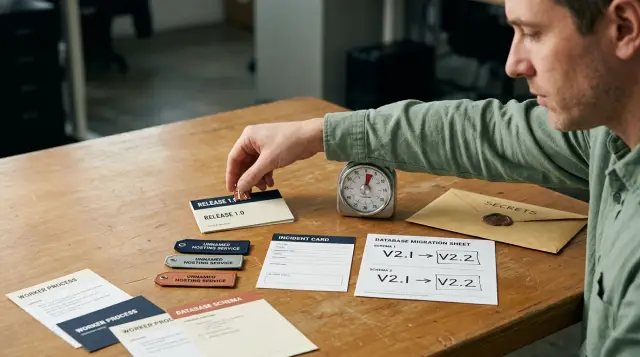
An inherited Next.js SaaS is not safe because its host has a Rollback button. It is safe when the old application can still run against the current database, with the right secrets, while someone who did not write the system works out what changed. On that test, Vercel gives the cleanest code rollback for a conventional Next.js app, Render gives the most explicit full environment model, and Railway gives a practical middle ground for a service plus database stack.
My default choice is Vercel when the application fits its managed Next.js model and the database already lives behind a disciplined migration process. I choose Render when I need disposable copies of several services and datastores defined as infrastructure. I choose Railway when the inherited app behaves more like a containerized service and the team wants a simple project canvas with isolated environments. None of those choices can reverse a destructive SQL migration or unrotate a credential.
The decision therefore starts with a recovery boundary, not a feature table. Code, configuration, data, background jobs, and browser assets move on different clocks. A host can switch code perfectly while the system stays broken because one of the other clocks has already advanced.
The same failure exposes three different recovery models
A fair comparison needs one incident, so use this one: an agency inherits a Next.js SaaS with Postgres, email login, a billing webhook, and a worker that sends queued messages. A release renames users.plan to users.plan_code, changes the worker payload, and rotates AUTH_SECRET. The developer tested a page preview against production data, merged at 16:00, and saw successful health checks. At 16:07, existing sessions started failing, the old worker began rejecting new payloads, and a seldom used admin route still queried users.plan.
The operator wants the previous code live again. That action sounds simple, but it asks five separate questions:
- Can the host route traffic to a known build without rebuilding it?
- Which environment variable values will that build receive?
- Did the migration remove data that the old build needs?
- Can preview traffic reach real user data or send real email?
- Will an automatic deployment immediately replace the recovery build?
Vercel can repoint production traffic to a previous eligible deployment at the routing layer. Its current rollback guide says this takes effect without a rebuild, and its Instant Rollback documentation warns that external databases and APIs do not roll back with the deployment. That warning is the center of the comparison, not a footnote.
Railway describes rollback as redeploying the selected previous deployment and restoring both its Docker image and custom variables. Render starts a new deploy using the selected build artifact and reuses the target deploy's service environment variables, while some shared environment group values remain current. All three preserve some old application state. They differ in exactly what they preserve and how quickly they return it to service.
Under this incident, the first rollback probably restores the admin route only if the database still exposes users.plan. It may invalidate every session if the restored deployment sees the wrong AUTH_SECRET. It may also leave two worker versions consuming incompatible jobs. A green platform event proves that deployment machinery worked. It does not prove that the SaaS recovered.
Immutable deployment is narrower than reversible release
The hosts all preserve deployment artifacts in some form, but immutable deployment does not mean reversible release. Immutability says the built artifact does not change after creation. Reversibility says the whole user facing behavior can return to a known state after code, configuration, and data have changed. The first property helps the second, but it cannot guarantee it.
This distinction catches inherited Next.js systems because a repository often contains several release units that look like one application. The web deployment may include server components, route handlers, and static assets. A separate process may run queue consumers. A scheduled task may execute from platform configuration. Postgres, object storage, a billing provider, and an email provider retain state elsewhere. Rolling back one immutable artifact changes only one row in that inventory.
Health checks narrow the view again. A check against /api/health may prove that the process started and can answer HTTP. It does not prove that an existing encrypted session can be read, an old database row can be updated, a webhook signature can be verified, or a queued job can be consumed. For this SaaS, the useful release check has to touch those paths without creating real customer effects.
I use two levels of checks. The platform health endpoint stays fast and side effect free so the host can decide whether an instance should receive traffic. A separate release probe signs in a synthetic account, reads and changes a disposable record, submits a test job, and confirms the worker result. The release probe runs before promotion and after rollback; the load balancer should never call it.
The browser adds another version boundary. A user can keep a tab open across deployment, then submit a form or request a server action from code loaded before the switch. Vercel's Skew Protection addresses supported Next.js asset and function skew, but application contracts still need tolerance. Railway and Render deployments also need the application to handle requests that began before traffic moved. Avoid changing action identifiers, cookie formats, and required request fields in a way that makes an open session fail immediately.
Background jobs create the longest overlap. A job written at 15:58 might run after the 16:00 release, and a retry might run after the 16:07 rollback. Producers and consumers therefore need a compatibility window longer than the web traffic switch. Version payloads, make new fields optional at first, and keep consumers able to reject an unknown version into quarantine instead of discarding it or retrying forever.
Build reproducibility deserves the same skepticism. A rollback that reuses a retained artifact is safer than rebuilding an old commit against today's package registry, base image tag, and build tools. Vercel points at an existing deployment. Render says it reuses a retained build artifact for ordinary rollbacks. Railway restores the selected Docker image in its documented rollback flow. Retention limits still decide whether that artifact exists when you need it.
Mutable container tags weaken the promise. Render explicitly warns that a rollback of a registry image referenced by tag can pull whatever the tag points to now, while a digest identifies the same image. The general rule applies beyond one host: record an image digest or platform deployment identifier as the recovery target. A Git commit alone is not a binary, and a rebuild of that commit is a new event.
Call a release reversible only when the team can restore a tested set of web, worker, schema, and configuration versions without guessing. That definition is stricter than the platform vocabulary, and it prevents the worst incident surprise: discovering that the button worked exactly as documented while the application stayed unavailable.
Vercel wins the pure Next.js code rollback
Vercel is the safest first choice when the recovery unit is a Next.js deployment and the stateful systems sit outside that unit. Each deployment gets a unique address, and production domains point at one deployment. An Instant Rollback changes that pointer to a previous production deployment instead of rebuilding source. This is the closest of the three to an atomic code switch.
The operational advantage is small cognitive load during an incident. An operator can inspect recent production deployments, identify a known commit, roll back, check status, and compare logs. The CLI sequence has a clear output shape:
vercel list
vercel inspect <bad-deployment-url>
vercel rollback <good-deployment-url>
vercel rollback status
vercel list returns recent deployments with their deployment addresses and age; the operator selects the production candidate. vercel inspect ties that candidate to its Git commit and configuration metadata. vercel rollback status tells the operator whether the routing change completed. The host's documentation also says a rollback disables automatic production domain assignment until someone promotes a deployment, which helps prevent the next push from silently undoing incident recovery.
There are boundaries. Hobby accounts can roll back only to the immediately previous production deployment, while higher plans can select other eligible production deployments. A preview that never received a production domain is generally not an Instant Rollback target. Retention policy still deserves inspection before an incident, even though Vercel retains recent production deployments under documented rules.
Vercel also has Skew Protection for supported Next.js versions. It helps keep a browser on assets and server functions from a consistent deployment while a new version rolls out. That reduces version skew during normal releases, but it does not reconcile two database schemas or two job formats. Treat it as protection against mixed application assets, not as transactionality across your stack.
Choose Vercel for this inherited SaaS only after confirming that its Next.js runtime assumptions fit the platform, its long running work has a suitable home, and every database change remains compatible with the previous application. If those conditions fail, the fast pointer swap can return old code to a world it no longer understands.
Railway keeps a service stack understandable
Railway is often easier to reason about when the Next.js app is one service among Postgres, a worker, and perhaps a private API. Its project and environment model groups those resources without pretending they are one reversible object. Railway environments isolate configuration changes, and temporary PR environments can provision affected services for a pull request.
A Railway rollback uses the selected deployment's source or image and restores custom variables associated with it, subject to plan retention. That pairing matters in the failure scenario because the previous application and its former AUTH_SECRET can return together. It is still a redeployment rather than a routing pointer change, so recovery includes startup and health behavior. Measure it on your own service instead of assuming the word rollback means instant.
PR environments can copy the shape of a base environment, including service references and variables. Railway's current guide explains that standard PR environments replicate the full base environment, while focused PR environments deploy affected services and their dependencies. That makes an inherited multi-service repo approachable: the reviewer can see whether the web service and worker agree on a payload before merging.
The unsafe part is inheritance. If a PR environment inherits production credentials or a connection string that reaches production data, isolation on the project canvas is cosmetic. Give previews a separate database, a mail sink, a test billing account, and secrets that cannot authorize production actions. A temporary environment should fail closed when a production-only variable is absent.
Railway supports a pre-deploy command that runs after build and before the application starts, with access to the private network and environment variables. It is a sensible place to run a migration, but placement does not make a migration reversible. If the command successfully drops users.plan, then the new service fails later, an application rollback cannot recreate the column contents.
Railway is my middle choice here. It exposes the relationship between services better than a frontend-centered deployment view, and it asks for less infrastructure definition than a full Render Blueprint. It becomes less safe when people edit production variables casually or let every service deploy independently without recording which versions belong together.
Render makes the environment boundary explicit
Render is strongest when the recovery question includes a declared web service, worker, database, and shared configuration. A Blueprint can define those resources, and a preview environment can create new instances of services and datastores for a pull request. Render's documentation is explicit that preview datastores do not copy production data. That default forces a team to decide how test data appears, which is healthy.
Preview environments require a Blueprint and an eligible plan. They can apply previewValue overrides and run an initialDeployHook after the first successful preview deployment. For an inherited SaaS, that supports a contained test: create the empty database, apply migrations, seed synthetic accounts, and exercise web plus worker behavior. It costs more setup than a page preview, but it tests the failure boundary that matters.
Render rollback is not a pointer flip. The platform starts a new deploy from a retained build artifact. The target deploy contributes its build artifact, start command, health check path, instance count, and service environment variables. Current service settings still govern items such as disks and custom domains, while environment groups have mixed behavior. The official rollback table is unusually candid about this split.
That split has two consequences. First, a service variable stored with the old deploy can return, but a value inside a shared environment group may stay at its current value. Second, a persistent disk never rolls back with the service. Render can restore disk snapshots separately, but application rollback and disk recovery are different operations with different risk.
Dashboard initiated rollback disables automatic deploys, while an API initiated rollback does not. An incident runbook must name the path the operator uses; otherwise two people can perform nominally identical rollbacks and leave different automation states behind. Build artifact retention also varies by workspace plan, so test how far back the Rollback action remains available.
For the scenario, Render offers the best preview fidelity if the entire stack is described in a Blueprint. It also gives the operator the most configuration details to understand during recovery. Choose it when that explicitness matches the team. Do not choose it because a Blueprint looks like documentation while its secret placeholders, external services, or manual dashboard edits remain undocumented.
A database migration decides whether rollback is real
Database compatibility matters more than the host once a release changes persistent data. Safe rollback means version N and version N minus one can both operate during the recovery window. The reliable pattern adds new structures first, moves reads and writes gradually, and removes old structures only after the old application can no longer return.
For the plan rename, do not rename or drop the column in the same release that changes the code. Add the new column, backfill it, and keep both values synchronized while old code may run:
ALTER TABLE users ADD COLUMN plan_code text;
UPDATE users SET plan_code = plan WHERE plan_code IS NULL;
The new application should read plan_code with a temporary fallback to plan and write both fields. A later release can stop reading the old field. Only after the rollback window expires should another migration remove plan. This takes more releases than a direct rename, and that inconvenience buys actual recoverability.
The same rule applies to job payloads. Add a version field and make consumers accept the old and new forms before producers emit only the new form:
{"version":2,"userId":"usr_123","template":"welcome"}
A worker that rejects every payload without version: 2 cannot coexist with queued version 1 jobs. Rolling back the web process may increase the mismatch by producing more old jobs. Drain, quarantine, or translate incompatible jobs deliberately; never rely on a process restart to make the queue consistent.
A pre-deploy migration command is good for sequencing, but a destructive migration needs a separate approval and backup check. Record the migration identifier, start time, completion state, and the tested recovery action. If reversal means restoring a database backup, state the expected data loss window before release. A snapshot restore can discard valid writes received after deployment, so it is not an ordinary rollback.
I argue against the popular recommendation to put prisma migrate deploy in an application start command. It feels safe because every instance becomes self configuring. In a scaled service, several instances may race or block startup, and a migration failure can turn an application restart into an outage. Run migrations once as a release action, inspect the result, then start the new application.
Secrets have versions even when dashboards hide them
A rollback needs the secret set that made the target application work, but restoring an old secret can reopen a credential that was rotated for security. Treat configuration rollback and credential rotation as separate decisions. The host stores values; your runbook must explain their meaning and acceptable lifetime.
Vercel variables are scoped to Production, Preview, Development, and optional custom environments, and changes apply to subsequent deployments. Its Instant Rollback documentation warns that the restored build can carry configuration assumptions that differ from current external systems. Railway says rollback restores custom variables from the selected deployment. Render restores service variables for the rollback but does not rewind the values inside shared environment groups.
Those differences make a simple secret inventory useful. Keep names and ownership, never secret values, beside the code:
AUTH_SECRET:
  owner: application
  rotation: dual-read
  rollback: previous value valid for 24 hours
BILLING_WEBHOOK_SECRET:
  owner: billing-provider
  rotation: accept old and new signatures
DATABASE_URL:
  owner: operations
  rollback: never point production code at preview data
dual-read here means the application temporarily accepts sessions or signatures made with either the old or new secret while issuing new ones with the current secret. Whether a library supports that varies. If it does not, expect a rotation or rollback to sign users out and write that user impact into the release record.
Never put production secrets in a preview merely to make it realistic. Use constrained test credentials and separate data. Also check build time exposure: any variable embedded into a NEXT_PUBLIC_ value becomes browser visible by design, regardless of how safely the platform stores it. An inherited codebase deserves a search for secret names in client bundles before the first production move.
Preview environments need isolated side effects
A preview is safe only when its side effects cannot escape. A unique URL and separate compute instance do not stop it from emailing customers, charging a card, consuming production jobs, mutating a shared database, or accepting a production webhook.
Vercel automatically creates preview deployments for non-production branches and supports preview variables, including branch overrides. This works well for the Next.js surface, but databases and workers usually need separate provisioning outside that deployment. Railway PR environments can reproduce connected project services and variables. Render preview environments can create fresh services and datastores from a Blueprint without copying existing data.
Use the same acceptance contract on every host:
- Create a synthetic user, sign in, and refresh the session after a redeploy.
- Apply migrations to an empty database and to a sanitized copy with the previous schema.
- Send email to a sink and billing requests to a test account.
- Process one old job payload and one new payload with the candidate worker.
- Roll the candidate back and repeat the sign in plus write path.
That fifth check is the one teams skip. They test forward deployment in preview, then assume rollback follows. A preview database built only from the newest schema cannot prove that old code tolerates the post-migration state. Keep a fixture representing the previous release, run the migration, deploy new code, then redeploy old code against the migrated fixture.
Protect previews from public access when they contain realistic customer workflows. Vercel offers deployment protection options, while Railway and Render let teams control environment access through their own project models and application authentication. Platform access control does not replace application authorization. Test that an ordinary preview user cannot reach admin routes or production integrations.
The recovery runbook must fit on one screen
During an outage, the safest host is the one whose recovery sequence the actual operator has rehearsed. A runbook should name evidence and stop conditions, not say “roll back if needed.” Put this compact record in the repository and fill it for every production release:
release: <git-sha>
previous: <known-good-deployment>
migration: <id-or-none>
compatible_with_previous_code: <yes-or-no>
secret_change: <name-or-none>
web: <deployment-id>
worker: <deployment-id>
recovery_owner: <person>
When the incident begins, freeze automated production deployment, preserve the failing deployment and logs, and decide whether data has changed. If the migration was additive and the former secret remains accepted, restore web and worker versions as one release set. Verify sign in, one read, one write, one queued job, and the billing webhook. Watch error counts before declaring recovery.
If the migration was destructive, stop calling the action a code rollback. Choose among a forward fix, a compatibility patch to the old application, or database recovery. A forward fix often preserves the most data. A database restore may be justified when corruption continues, but it needs an explicit cutoff and reconciliation plan for writes after the backup.
On Vercel, record the exact production deployment address and confirm rollback status plus production domain state. On Railway, record each service deployment because the web app and worker can drift. On Render, record the target deploy, whether rollback came from the dashboard or API, and which environment groups or disks remain current.
Run this exercise before changing hosts. Time the recovery, then open an existing session and complete a write. If the platform says success while that user journey fails, the missing step belongs in the runbook. Host migration will not repair an unknown application dependency.
Pick the host after mapping the inherited system
The choice is Vercel for the cleanest Next.js deployment switch, Railway for a compact service and database workspace, and Render for a declared multi-resource environment with high fidelity previews. That ranking changes when the inherited code has a persistent disk, unusual runtime work, several independently deployed workers, or manual infrastructure outside the host.
Before committing, map five things: runtime processes, data stores, queues and scheduled work, secret owners, and external side effects. Then mark which host object owns each one and whether its rollback action changes it. Any blank cell is part of your recovery plan, not a reason to assume the platform handles it.
An inherited AI-generated project often hides database calls in server actions, repeats authentication logic, and mixes deployment configuration with application code. FixMyMess can diagnose that codebase, repair logic and security issues, refactor it, and prepare deployment with expert verification, but the host decision still needs the recovery boundary described here.
Do one destructive thought experiment before signing off: assume the new code has been live for seven minutes, users have written data, a secret changed, and the old worker still has jobs. Ask the operator to recover without the original developer. Pick the host on the quality of that answer. A fast Rollback button is useful only after the application has earned the right to go backward.
FAQ
Which host has the fastest rollback for a Next.js app?
Vercel has the clearest fast path because it can repoint production traffic to a previous eligible deployment without rebuilding. That advantage covers application code and associated deployment state, not an external database or every changed secret.
Does rolling back a deployment also roll back Postgres?
No. Vercel, Railway, and Render application rollbacks do not reverse schema changes or restore deleted rows in an external database. Use compatible migrations for ordinary releases and treat backup restoration as a separate data recovery event.
Is Vercel safer than Railway for an inherited SaaS?
Vercel is usually safer when the SaaS is a conventional Next.js application with external managed data and disciplined migrations. Railway can be easier when the app includes a worker, database, and other services that operators need to see together.
When should I choose Render instead of Vercel?
Choose Render when you want the web service, workers, databases, and configuration declared together and reproduced as preview resources. Expect more setup, and read its rollback table carefully because disks and some shared configuration do not rewind with a service.
Can a preview environment safely use the production database?
It should not. A preview can run unreviewed code, and one wrong query can alter or expose real data. Give it isolated data, constrained test credentials, and sinks for email, billing, and other side effects.
What makes a database migration safe to roll back?
The previous and new application versions must both work after the migration. Add new columns or tables first, keep old paths working during the recovery window, and remove old structures in a later release.
Should database migrations run when the app starts?
I avoid that pattern for production services. Several instances can race or block startup, and a migration error can turn a routine restart into an outage. Run the migration once as a release action and inspect its result before starting new code.
Do old deployments keep their old environment variables?
The exact behavior differs by host and configuration scope. Railway restores custom variables with the selected deployment, Render restores service variables but treats shared groups differently, and Vercel rollback can restore a build whose assumptions differ from current external configuration.
How do I test rollback before moving an inherited app?
Deploy a release fixture, apply the next migration, run the new code, then restore the old code against that migrated database. Verify an existing session, a read, a write, an old queued job, and every external side effect that matters.
What should a rollback runbook contain?
Record the current and known good deployment identifiers, migration state, secret changes, web and worker versions, recovery owner, and user checks. Also state whether automatic deploys pause after rollback and which data or configuration the platform leaves unchanged.