We need it by Monday request: negotiate scope without risk
Learn how to handle a we need it by Monday request with clear questions, a safe scope, and a written deferral list that protects quality and trust.
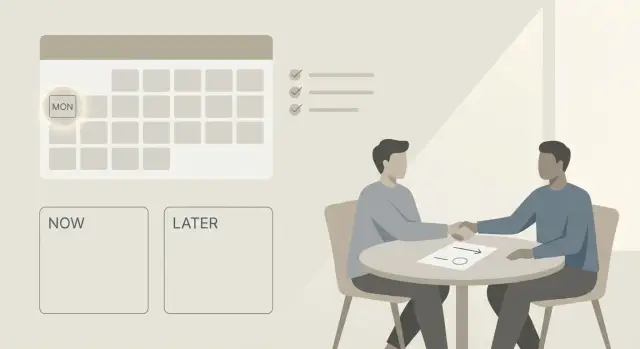
What a "by Monday" request is really asking for
A "we need it by Monday" request is rarely just about the calendar. It usually shows up because someone has a moment they can’t miss: a sales call, a demo, an investor meeting, or a team kickoff where they want to show progress.
Under the deadline, there’s often a hidden ask:
- Speed: something visible, fast.
- Certainty: no surprises in front of other people.
- Reassurance: confirmation that things aren’t falling apart.
The hard part is that "done" can mean very different things. For one person, "done" means the button works on their laptop. For another, it means it works for real users, with login, error handling, and a clean handoff. If you don’t name the version of "done," you can hit Monday and still disappoint them.
When people say "done," they usually mean one of these:
- Demo-ready: looks good in a walkthrough, even if the edges are rough.
- Usable internally: the team can try it without constant support.
- Production-ready: secure, stable, and safe for real customers.
- Launched: live, monitored, and ready for support.
You can stay calm and buy time without saying "no" by shifting the conversation from the date to the outcome:
"I can get you something by Monday. Before I confirm, what has to be true on Monday for you to call it a win?"
If the real goal is an investor demo, the right answer might be a guided demo flow with realistic data and a backup plan, not a full launch. That’s still a Monday win, just a different kind of "done."
What can go wrong when you compress the timeline
A Monday deadline quietly changes how decisions get made. When time is tight, people accept unknowns, skip checks, and assume the last 10% will be easy. That last 10% is usually the part that hurts.
Quality risk: rushed work misses edge cases. The user who resets a password twice. The form that fails on mobile. The checkout that breaks when a coupon is applied. These gaps often show up as broken flows, not small cosmetic bugs, because the work was never tested end to end.
Operational risk: short deadlines push teams into late nights and "we’ll test it after" thinking. Code gets merged without review. Testing becomes a quick click-through. Monitoring and rollback plans get skipped. If something fails Monday morning, you’re fixing it under pressure with customers watching.
Trust risk: when you promise the full scope and deliver a partial version, people feel surprised, even if you worked hero hours. The issue isn’t effort. It’s expectations. A calm "here’s what will be done by Monday, and what will not" conversation protects confidence.
Also, deadlines attract "just one more thing." Each add-on sounds small, but it creates hidden work: more states to handle, more permissions, more validation, more screens, more devices to test. Under pressure, those extras quietly turn Monday into Tuesday.
Fast questions that clarify the real need
A "by Monday" request often mixes two things: a real business moment (demo, launch, internal review) and a vague idea of what "done" means. Your job is to turn urgency into a clear, testable goal.
Ask short questions that force specifics, then write the answers down.
Five questions that surface the real target
- Who will use it on Monday, and what are they trying to accomplish in the first 2 minutes?
- What is the single action that must work end to end with real data? (Sign up, pay, submit a request, generate a report.)
- What is allowed to be manual, mocked, or handled by a human behind the scenes for now?
- Describe success in one sentence that anyone can verify without debate.
- What is the true cutoff time, including time zone and meeting start time?
Once you have answers, repeat them back as a crisp summary. If they can’t agree on the one must-work action, you don’t have scope yet. You only have pressure.
Example: A founder says, "We need the app by Monday." After the questions, you learn it’s a 10-minute investor demo at 9:00 AM PT. The only must-work flow is logging in and generating one report for a sample customer. Payments, team invites, and email notifications can wait, or be shown with static data.
If the code is fragile (common with AI-generated prototypes), this step matters even more. It protects you from promising "everything" when the real need is one reliable path.
Define a "safe Monday" scope
A safe Monday scope is the smallest result that is genuinely usable on Monday, even if it’s not pretty and not complete. Most people don’t actually mean "ship the whole product." They mean "give me something I can show, sell, or use to unblock the next step."
Start by naming the minimum usable outcome in plain words. Avoid feature lists like "OAuth, roles, admin, exports." Describe what a person can do: "A user can sign up, create one item, and see it again later." If Monday’s delivery can’t be described in one or two sentences, it’s probably too big.
Next, protect one primary user journey. Pick the single path that matters most (usually the demo path or the path that unlocks revenue) and commit to making that path reliable end to end. Teams lose time when they try to keep three journeys half-working instead of one journey solid.
A simple way to separate scope without debate:
- Must-have: required to complete the primary journey once.
- Nice-to-have: improves speed, polish, or reduces support.
- Later: adds a new user type, workflow, or integration.
- Not Monday: anything you can’t test in the remaining time.
Finally, agree out loud on what will not be included on Monday. Name deferrals as protection for quality: "No password reset yet," "No admin dashboard," "No mobile layout fixes." If the code is fragile, explicitly defer high-risk changes like major auth rewrites or database reshaping.
Put it in writing: scope, assumptions, and deferrals
A Monday deadline gets safer the moment it turns into a one-page note everyone can read and agree to. The goal isn’t paperwork. It’s removing guesswork so nobody is surprised.
Write the Monday deliverable as outcomes, not tasks. Then add acceptance criteria as simple checks a non-technical person can verify.
Instead of "finish checkout," use checks like:
- A test user can add an item to cart and complete a payment in the staging environment.
- An order confirmation email arrives within 2 minutes.
- If payment fails, the user sees a clear message and no duplicate order is created.
Next, make assumptions explicit. These often decide whether Monday is possible: access to accounts, stable test data, a working staging environment, and who can approve copy or legal language.
Capture the agreement in five scan-friendly lines:
- Deliverables (Monday): 1 to 3 concrete outcomes.
- Acceptance criteria: 3 to 6 plain checks that prove it works.
- Assumptions: access, data, environments, required approvals.
- Dependencies: what must be provided, by whom, and by when.
- Deferrals: what is not included and when it will be revisited.
Deferrals should be specific. "Polish later" turns into conflict. "Admin dashboard filters deferred; revisit Wednesday 2pm" is clear.
If the codebase is fragile, add one more line: what happens if a blocker appears. For instance: "If authentication breaks, we ship without social login and keep email login only."
What to defer (and what not to defer)
A Monday deadline can be reasonable, but only if you separate "must work" from "nice to have." Deferring the right things protects quality and keeps you from shipping something that breaks the moment real users touch it.
Safe deferrals
These usually don’t block Monday if your core flow works:
- Visual polish (spacing, design tweaks, animations, final copy rewrites).
- Extra pages, roles, and edge-case flows.
- Automation (admin dashboards, alerts, reporting).
- Performance extras (caching, load testing, scaling work), as long as normal traffic is fine.
- Cleanup refactors that aren’t required for correctness.
Non-negotiables
Some basics aren’t optional, even on a tight deadline:
- Security: no exposed secrets, no risky endpoints, no "temporary" bypasses.
- Authentication safety: correct sessions and access control.
- Data integrity: correct writes, safe deletes, protection against bad input.
- Money logic: accurate totals, clear status, no double-charges.
- Recovery: enough logging to debug and a rollback plan.
Concrete example: If a founder wants "sign up, create a project, invite a teammate" by Monday, you can defer a fancy invite email template and an admin dashboard. You should not defer permission checks or input validation, because that’s where real damage happens.
If the codebase is fragile, it’s often faster to cut scope further and harden the basics first.
A step-by-step way to negotiate scope under pressure
When someone drops a Monday deadline, the safest move is to turn pressure into clear choices. You’re not saying "no." You’re defining what "done" means and what will wait.
-
Confirm the goal in one sentence. Ask: "On Monday, what should a user be able to do, end to end?" Write it down and read it back.
-
Offer two options. A safe scope you can stand behind, and a bigger scope with a later date. Example: "Option A: a stable demo flow by Monday. Option B: demo plus payments by Thursday."
-
State deliverables and deferrals clearly. "By Monday you get X and Y. We will not do Z yet." Keep it specific.
-
Get a written yes on the deferral list. One sentence is enough: "Reply 'approved' to this list of deferred items so we don’t argue about it Sunday night."
-
Set check-ins and a change cutoff. Put two short check-ins on the calendar and set a hard cutoff: "No new requests after 3 pm Friday unless we remove something else."
If the code is fragile, treat stability as part of scope, not a bonus.
Common mistakes that blow up Monday deliveries
Most Monday failures aren’t about effort. They happen because the work was never defined clearly enough to finish safely.
These are the mistakes that usually cause the blow-up:
- Saying yes before agreeing on what "done" includes (and what it does not).
- Allowing new requests after work starts, without trading them for something else.
- Mixing must-fix items (broken auth, data loss) with nice-to-haves (polish, extra screens).
- Skipping review and testing because "it worked once," then finding the failure only after handoff.
- Keeping risks quiet until the last minute instead of warning early.
One simple shift helps: separate "ship" from "improve." Monday is for shipping the smallest safe slice. Improvements get scheduled for Tuesday and beyond.
Example: A founder wants an AI-generated app ready for a Monday investor call. The team tries to fix login, add a new pricing page, and redo the dashboard layout. By Sunday night, they’re stuck in merge conflicts and untested changes. A safer plan is: fix login, remove the broken dashboard widget, and hardcode demo data for the call. The pricing page gets deferred. The layout changes wait.
Quick checklist before you commit
Before you say yes to a Monday deadline, pause and get a small, safe scope on the table. This takes 10 to 20 minutes and can save you from shipping something that breaks on first real use.
Write down the goal in one sentence and get a clear "yes" from the requester. If you can’t explain what "done" means in plain words, you’re not ready to commit.
Then run one real user flow end to end. Pick the single path that matters most (for example: sign in, create the thing, and see it saved). Don’t assume it works. Click it through on a clean browser or test account.
Use this commit checklist:
- Goal and success check: one sentence goal agreed, plus how you’ll verify it on Monday.
- One flow tested end to end: the main path works with real data.
- Deferrals documented and approved: a short list the requester explicitly accepts.
- Safety and security basics: no exposed secrets, no hard-coded admin logins, no auth or payment bypasses.
- Rollback and handoff: who rolls back, how, and a short note describing what shipped and what’s next.
If any item is missing, the best move isn’t to work faster. It’s to narrow scope until the checklist is true.
Example: delivering a realistic Monday scope without panic
A founder shows you an AI-built prototype. The demo looks fine, but real users hit weird failures: signup loops, payments time out, and a refresh logs you out. Then comes the Monday deadline.
Instead of agreeing to "the whole app," you pin down one business outcome: one signup-to-checkout flow that completes reliably for a normal user. That becomes the promise. Everything else either supports that flow or moves out of scope.
A safe Monday scope often looks like this:
- Fix authentication so sessions stay valid.
- Add clear error handling (no blank screens).
- Run basic security checks (no exposed secrets, no obvious injection holes).
- Create a short, repeatable happy-path test run.
And explicitly defer anything that multiplies scenarios, like multi-role permissions, admin dashboards, and UI polish that doesn’t affect completion.
Write it down in plain language: "By Monday, a new user can sign up, log in, add one item, and complete checkout. If any step fails, the user sees a clear message and can try again." Then write the Tuesday plan: expand roles, build the admin view, and polish the interface once the core flow is stable.
Next steps when the code is fragile (and time is short)
When the code already feels shaky, the first job isn’t speed. It’s choosing the least risky path that still meets the real need.
Decide early: do you need a repair pass or a partial rebuild?
- A repair pass makes sense when the basics work and the bugs are contained.
- A partial rebuild makes sense when one area (often auth, payments, or data access) is so tangled that every fix breaks something else.
Run a short triage and end with one decision: what are you comfortable shipping on Monday, and what must wait.
A tight triage agenda:
- Reproduce the top 1 to 2 user flows that must work.
- List failures and rank them by user impact and risk.
- Pick one Monday path: repair, partial rebuild, or demo-only.
- Agree on deferrals by name.
- Assign owners and set the next check-in.
AI-generated prototypes often hide problems that only show up later: exposed secrets, broken authentication, injection risk, or a structure that can’t survive real usage. If you suspect that’s the situation, an outside read can be the difference between a controlled delivery and a Monday meltdown.
If you want help stabilizing an AI-generated codebase fast, FixMyMess (fixmymess.ai) does codebase diagnosis and repair, including security hardening and deployment prep. A free code audit can also help you pick a realistic Monday scope before you commit.